The third edition of the EAPIL Winter School will take place in Como between 2 and 6 February 2026. The upcoming edition’s general topic is Values in Private International Law.

Day 1 will be about the protection of weaker contractual parties. The concerns surrounding torts will be dealt with in Day 2. Day 3, on “vulnerable people”, will address the current challenges the arise in relation with children and with adults who are unable to protect their interests. Day 4 will revolve around the relationships between the values underlying EU texts and those inspiring developments in other regions and worldwide. On Day 5 the focus will shift to a selection of specific fields, such as poverty, and issues at the crossroads of business and human rights.

Registrations are open until 20 January 2026. Detailed information about the program, the registration process and the fees can be found here.

For further inquiries: eapilws@gmail.com.

The Seminar: A Report

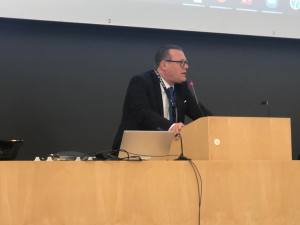
Silvia Marino, the Coordinator of the School, made a general presentation of the initiative.

Gilles Cuniberti (Methods in Private International Law: Protecting People and Values) introduced a provocative scene, where the traditional neutrality of private international law will be confronted with the more recent trends of colouring it with new values.

Javier Carrascosa González and Maria Asunción Cebrian Salvat (Consumer) distinguished between ‘traditional’ consumer contracts and ‘new consumers’, including so-called ‘professional consumers’, that represents a challenge to the traditional protective approach.

For Erik Sinander (Worker and Collective Rights) the differences in national laws question the potential role of private international law in the fragmentation and on its methods and advanced possible litigation strategies in industrial actions, where the harm is not accidental, but on purpose.

Anna Wysocka-Bar (Passenger) recalled the high number of legal acts regulating the right of the passengers, and their diverse natures, the consequential difficulties in coordination and in the identification of the role of the Rome I regulation.

Thomas Kadner Graziano (Torts Victims as Vulnerable Parties? and Product Liability) spoke about the protection of the victims of torts. Challenging the interpretation of the Court of Justice of the European Union of Article 7 point 2 of the Brussels I bis regulation, in personality rights the identification of the person and the right to be protected is not immediate, thus weakening the traditional views of tortfeasors and victims. Under the products liability, he disclosed the discussion of real cases related to the role of consumer protection in Article 7 point 2 of the regulation.

Eva-Maria Kieninger (Environmental Claims) shed some light on the importance of choice of law in environmental claims due to the different liability (strict of by fault) that can be envisaged in national legislations and announced a discussion on the current practice in climate change litigation.

Cristina González Beilfuss (Vulnerable Adults) previewed a discussion of the EU proposals on the protection of vulnerable adults, in the light of the UN Convention on the Rights of Persons with Disabilities triggering a favourable approach to voluntary measures.

Sara De Vido (Women) proposed a critical conversation on private international law categories, making use of feminist and gender theories to imbalance the person. Discussing the very same term woman, she faces cross-border cases on violence.

For Laura Carpaneto (Children and Parenthood) the developing concept of parentage/parenthood/filiation questions its very foundations, starting from the principle that identity of the mother of a child is always certain. In the reproductive market, the risk of commodification of children is real.

Javier Carrascosa González (Mothers and Children in Surrogacy) followed this path, stressing that the legal protection that private international law shall offer mechanisms to prevent children from being treated as objects and the exploitation and deception of the women involved.

Hans van Loon (The EU in the HCCH) opened the presentation of Day 4, illustrating the main features of the impact of the EU private international law in the HCCH Conventions. After the accession of other non-European countries, more synergy and complementarity between global and regional are needed.

In a similar vein, Veronica Ruiz Abou-Nigm (The EU and Third Countries) focussed on the conceptualisation of private international law in other regions, such as South America and Asia. The connections must be global and regional, so that the values discussed in other regional system can develop a global private international law shape.

A common point can be the legal treatment of immigrants and the quest for integration. Hans van Loon and Veronica Ruiz Abou-Nigm (Migrants and Integration) distinguished different kind of immigration, asylum seekers and refugees, protected by international conventions, and labours migrants, in need of a different system of protection.

Recalling the fundamental values enshrined in Article 2 TEU, Johan Meeusen (Minorities: Equality through Private International Law) stressed the significance of equality for conflict of laws in a broad sense. In the lecture, he aims to analyse the inclusion of minority groups through adequate private international law instruments.

Geert van Calster (Business and Human Rights) discussed forum shopping and applicable law as a clear help in business and human rights litigation, as the recent English judgment in Municipio shows. At the same time, jurisdictional battles bleed claimants in human rights cases of scarce resources when they cannot have their claim funded.

Stefano Dominelli (The Right of Nature) showed new frontiers, related to the attribution to legal personality to the nature, or to some parts of it. The potential recognition of a legal status imposes original solutions in the cross-border protection of the environment, that can lead to extraterritoriality.

Finally, Cristina González Beilfuss showed a macro perspective to the topic of Poverty in Private International Law. She left us three questions for future discussion: whether the theme is present in the private international law-related aspects reflections; whether conflict of laws can fight poverties, for example with measures in cooperation with authorities; whether it is partly responsible for inequality and poverty.

— Attendees and lecturers of the second edition.


Still Unsure whether to Attend? See What a Past Attendee Thinks of His Experience!

Paul Lorenz Eichmüller, who took part in the 2025 edition, speaks of the EAPIL Winter School as an opportunity to meet an “enormous variety of speakers with their diverse expertise”, and “devote fully to private international law for an entire week”.

This is, he adds, an “experience which I can definitely recommend to everyone who wants to take their private international la skills to the next level”.


— Paul Lorenz Eichmüller and Fabian Pollitzer on the shores of Lake Como

After two successful editions (here and here), the new edition of the EAPIL Winter School is scheduled to held on-site in Como, in the cloister of the Basilica di Sant’Abbondio, from 2 to 6 February 2026.

It is organised by the European Association of Private International Law and the Department of Law, Economics and Cultures of the University of Insubria in Como, in cooperation with the University of Murcia and the Jagiellonian University in Kraków.

The general topic of the 2026 edition is Values in Private International Law. The full programme can be found here.

Early-bird registration fees are offered to those enrolling before 10 December 2025.

PhD students, young scholars, young practitioners and EU private international lovers, generally, are encouraged to apply.

Want to know what former participants think of their time in Como?

Wojciech Wydmański, Lawyer and PhD Student at the Uniwersytet Kardynała Stefana Wyszyńskiego in Warsaw, participant in 2025, says that the School is “a unique course that allows you to explore various aspects of private international law”.

He appreciated the opportunity to discuss his research with experts, “which was very helpful in furthering my doctoral work”. The connections with other participants, he said, were remarkable: “during the course, I was able to meet colleagues with similar interests, with whom I remain in contact to this day”.

For Ranegül Camiz, Post-Doctoral Researcher at Erciyes University, Kayseri, “the discussions throughout the sessions were remarkably engaging. The questions raised and contributions made by attendees enriched the debates and reflected a shared enthusiasm for understanding how international family law continues to evolve in response to social change”.

The Winter School, she added, “was a perfect blend of academic excellence, cross-cultural exchange, and personal growth: tt strengthened my passion for Private International Law and motivated me to further explore the complexities of personal status and family relationships in cross-border contexts”.

For further information on the Winter School, write to Silvia Marino, the director of the School, at eapilws@gmail.com.

An e-mail has been sent to the members of the European Association of Private International Law, to invite them to attend invitation the a meeting of the General Assembly, due to take place via Zoom on Friday, 28 November 2025, at 5 pm CET.

The Assembly will discuss, inter alia, about possible amendments to the EAPIL Statutes regarding the assignment of functions of the Board of Administration by the General Assembly and the renewal of the Board itself.

Members who have not received such an invitation are invited to check their spam folder. Please, make sure the address of the Association’s Secretary General, secretary.general@eapil.org, is among your registered, or trusted, contacts, to avoid similar issues in the future.

Invitations were sent to the e-mail address that each member has shared with the Association. If you’re a member, and have recently changed your address, please update your personal information through MyEAPIL, the area reserved to members in the EAPIL website.

If you have queries, or need assistance, feel free to get in touch with the Secretary General of the Association, Prof. Giesela Rühl, at secretary.general@eapil.org.

According to the EAPIL Statutes, participation in the General Assembly is open to all the members of the Association provided that they have paid their annual membership fees (€ 50 for ordinary members, € 30 for associate members and € 200 for institutional members).

Fellow EAPIL members who haven’t paid their fees for 2025 (or for any of the previous years) are invited to take a moment to settle any outstanding balance. This can be done by bank transfer to the Association’s account or by PayPal: all the necessary details are here.

To check whether any fees remain due, members may, again, use MyEAPIL or get in touch with Association’s treasurer, Apostolos Anthimos at treasurer@eapil.org.

See as many of you as possible on 28 November 2025!

Building on the success of the two previous editions (here and here), the third edition of the EAPIL Winter School is currently being organised by the European Association of Private International Law and the Department of Law, Economics and Cultures of the University of Insubria in Como, in cooperation with the Law Faculty of the University of Murcia and the Law Faculty of the Jagiellonian University in Kraków.

The Winter School will once again be held on-site in Como, in the cloister of the Basilica di Sant’Abbondio.

It will run from 2 to 6 February 2026. Three additional lectures will be offered on-line on 9, 17  and 24 February 2024.

The general topic of the third edition will be Values in Private International Law.

The various facets of the subject will be discussed by a rich list of speakers. Some of them are mentioned below; others will be presented in the future previews, which will also appear on the EAPIL blog.

Erik Sinander (Stockholm University) will give two lectures: The Protection of the Worker and the Collective Rights in Work. The protection of consumers and passengers will form the object of lectures by Javier Carrascosa González and Maria Asunción Cebrian (University of Murcia) and Anna Wysocka-Bar (Jagiellonian University in Kraków),.

Sara de Vido (University of Venice) and Nadia Rusinova (attorney at law) will share their expertise on the International Protection of Women and on The Best Interests of the Child in International Proceedings, respectively.

Geert van Calster (Katholieke Universiteit Leuven) will discuss Human Rights and Business, while Johan Meeusen (University of Antwerp) will speak about Minorities: Equality through Private International Law.

Stefano Dominelli (University of Genoa) will conclude the week with a final Workshop on the Rights of the Nature and case studies.

The Winter School is aimed at PhD students, young scholars, young practitioners and EU private international lovers, generally!

Want to know what former participants think of their time in Como? Georgios Kotlidas, Attorney at Law and LL.M. in International & EU Law attended the 2025 edition. He appreciated the “combination of top quality lectures and workshops (…) and networking opportunities to meet highly educated and driven colleagues from all over Europe. This was a profoundly successful academic week”.

Registrations will open around 20 September 2025.

Requests for further information can be submitter to Silvia Marino, the director of the School, at eapilws@gmail.com.


Building on the success of the two previous editions (here and here), a new edition of the EAPIL Winter School is currently being organized by the European Association of Private International Law and the Department of Law, Economics and Cultures of the University of Insubria in Como, in cooperation with the Law Faculty of the University of Murcia and the Law Faculty of the Jagiellonian University in Kraków.

It will be held again on-site in Como, in the cloister of the Basilica di Sant’Abbondio, from 2 to 6 February 2026.

The general topic will be Values in Private International Law. Lectures will deal with traditional topics, such as the protection of weaker contractual parties, to challenges that have surfaced in more recent times, such as the role of private international law in the realisation to the rights of minorities, migrants and vulnerable persons.

The Winter School is aimed at PhD students, young scholars, young practitioners and EU private international lovers, generally!

Want to know what former participants think of their time in Como?

Alix Ernoux, a teaching assistant at the University of Liège, regards her participation in the 2024 edition a “career-changing experience”. Here’s what she said:

I left the Winter School with a renewed passion and determination to specialize in this field. It sparked my decision to dive deeper into research on the complex intersections of international family law, human rights, and belgian law. It has been a crucial step in shaping my academic journey, and I’m excited to continue exploring this fascinating area of law in greater depth.

Aleksandra Wasielewicz, a doctoral student at the Nicolaus Copernicus University in Toruń, shared her thoughts of the 2024 and 2025 editions of the Winter School.

She said she would strongly recommend participation

to anyone interested  in private international law… Insightful lectures by prominent experts, in-depth discussions, and a sense of community with people from so many countries who share interests and enthusiasm for private international law.

Thanks to both testimonials!

The full program of the 2026 edition of the Winter School will be published in September 2025. Practical details on the registration process and the fees will be provided on that occasion.

For information, please send an e-mail to eapilws@gmail.com.

This post was written by Silvia Marino, Professor of EU law at the University of Insubria in Como, and Director of the EAPIL Winter School.


The second edition of the EAPIL Winter School in European Private International Law took place at the Department of Law, Economics and Cultures of the University of Insubria in Como from 10 to 15 February 2025.

The course was organized by the University of Insubria in partnership with the University of Murcia and the Jagiellonian University in Kraków. Financial support was provided by the International Insubria Summer/Winter Schools programme and through a Jean Monnet Module named European Private International Law: Recent Trends and Challenges (EuPILART).

The programme, prepared by a dedicated EAPIL Working Group consisting of  Silvia Marino, Javier Carrascosa González, and Anna Wysocka-Bar, addressed a broad range of topics concerning Multistate Torts.

Thirty participants, coming from Austria, Brazil, France, Germany, Greece, Hungary, Italy, Pakistan, Poland, Turkey, the United Kingdom and Ukraine, attended the School. Most were either PhD students with an interest in European Private International Law or young practicing lawyers.

10 February

The course started with a welcome address by the President of EAPIL, Gilles Cuniberti, and a presentation of EAPIL and its ongoing projects.

Thomas Kadner Graziano (University of Geneva) provided an overview of the current challenges of cross borders tort law. He presented the main difficulties surrounding the localisation of torts with respect both to jurisdiction and the applicable law. He then discussed with the attendees the application of the current rules in two case studies related to product liability.

In the afternoon, Sylwia Żyrek (Deputy Director of EU Law Department at Chancellery of Prime Minister of Poland) presented an analysis of the grounds of jurisdiction according to EC/EU instruments. She discussed the case law of the Court of Justice of the European Union and its approach to the interpretation of the rules in force. In particular, she pointed out the principles set by the case law and their application to the most challenging cases, such as actions for negative declarations and harmful events producing injuries and losses in more than one State.

Javier Carrascosa González (University of Murcia) discussed the challenges of the general rules for the determination of the applicable law. He went through the rationale of Article 4 of the Rome II Regulation, discussing case studies that evidence its strengths and drawbacks. He challenged the notion of State for private international law purposes, also looking to future technological developments that stress test the meaning of localisation for the determination of the applicable law.

11 February

Day two was devoted to possible solutions to multiple jurisdictions at the time of lodging a claim of during the proceedings on the merits.

It started with a lecture on the HCCH parallel proceedings project. Louise Ellen Teitz (Roger Williams University) presented the developments of the HCCH Jurisdiction project and the current state of the art in the draft of an eventual future Convention. She stressed the difficulties in reaching legal satisfactory agreements and discussed the solutions proposed by the Working Work both from common law and civil law perspectives.

Veronica Ruiz Abou-Nigm (University of Edinburgh) offered a more in-depth analysis of the EU system, from the definitions of lis alibi pendens and related actions, to the current normative solutions in the light of the case law of the Court of Justice of the European Union.

She also presented the different approaches applied in the systems of common and civil law and their interference.

Geert Van Calster (KU Leuven) focused on the rules on multiple defendant in EU Law, in both a theoretical and practical perspective. During a fruitful debate on the case law of the Court of Justice of the European and of the England and Wales Court of Appeal, he stressed the different approaches and the possibility of strategical or even abusive litigation in the twists and turns of Brussels Ibis Regulation.

12 February

On day three, Paivi Hirvelä (Former Judge of the European Court of Human Rights) started the session on the relationships between the freedom of expression and the personality rights providing an overview on the case law of the European Court of Human Rights on Article 10 of the European Convention on Human Rights, trying to strike a balance between the two in a human rights protection related approach.

Javier Carrascosa González followed with a lecture on Jurisdiction for defamation cases and libel tourism, focussing on the consequences of the mosaic approach in online defamation cases. He tested the functionality of the current EU solution from the perspective of some case studies related to the personality rights of worldwide famous people.

Caterina D’Osualdo (European Commission, Seconded National Expert in DG JUST) presented the EU Commission report on the application of Rome II Regulation and the ideas for future normative developments in the rules on the applicable law. She offered an insight on the anti-SLAPP directive, underlining the benefits of a harmonisation of national procedural laws in the specific case of abusive claims.

The day ended with an inspiring lecture of Tobias Lutzi (University of Augsburg) on crypto assets. He discussed the notion of damage in these cases, and through tradition private international alw showed how contractual and non-contractual matters can be closely intertwined in the protection of these patrimonial rights. He proposed possible alternative approaches within the role of the network.

13 February

Day four started with a lecture by Magdalena Lickova (Référendaire at Court of Justice of the European Union) on jurisdiction and applicable law to unfair competition and acts restricting free competition. She focussed on the development of the case law of the Court of Justice of the European Union taking also in consideration the comments of the legal scholars, demonstrating how the tort can be localised for the purposes of private international law, notwithstanding the potential multiplicity.

Olivera Boskovic (Université Paris Cité) discussed cases related to climate change litigation, starting from the very nature of these claims and the possibility to bring them before a national Court, to the impact of the EU rules on jurisdiction and on applicable law in order, also for the purposes of favouring the alleged victim. A debate on the rules of safety and conduct pursuant to Article 17 of the Rome II Regulation was stimulated.

In the afternoon, Marta Pertegás Sender (Maastricht University/University of Antwerp) challenged the classic territorially principle for the protection of IP rights, offering remarks on some weakness of the case law of the Court of Justice on jurisdiction and on Article 8 of the Rome II Regulation. She presented also EU cases expected to be decided soon and opened a discussion on them.

The end of the day was devoted to a short presentation of the ongoing works of the EAPIL Working Group on the feasibility of a European Private International Law Act. Thomas Kadner Graziano as Chair of the Working Group, illustrated its working methodology, the challenges and the opportunities that this act could offer in the future.

14 February

Day five started with a focus on the human rights in cross borders situations. Satu Heikkilä (Legal Counselor) presented the challenges of cross border enforcement under the ECHR prongs of the right to fair trail, the right to private life and the right to property. For this, she discussed a set cases related to the alleged violation of these rights in the enforcement of judgments in cross border situations, decided by the ECtHR.

Francisco José Garcimartín Alférez (University Autónoma of Madrid) presented the 2019 HCCH Convention in the light of the enforcement of irreconcilable judgments. After focussing on the main definition, he offered a practical approach to the possible difficulties of enforcement in the light of multiplicity, leaving room to debate. Then, he showed potential difference with the EU legal system, following to the case law of the Court of Justice.

In the afternoon, participants were invited to exchange national practises to their knowledge, from the point of view of academia and legal practice. The workshop, moderated by Silvia Marino, touched upon artificial intelligence, the impact of EU legislation on national procedural law, the localisation of specific torts (climate change; competition law infringements and car traffic accidents).

From the evening and the day after, parallel lectures were offered on topics “extra torts”, in order to discuss similar problems of multiplicity in other areas of the law. Participants were invited to choose among two parallel sessions and take part in the discussion, based, among other things, on reading materials that had been shared before the start of the Winter School.

On Friday the options were between Succession: the very special coordination of jurisdiction (held by Anna Wysocka-Bar, Jagiellonian University in Kraków) and The family and the law of torts in EU: A case study on international child abduction, held by Nadia Rusinova (The Hague University, attorney at law).

15 February

Saturday morning parallel session continued with a seminar devoted to Family matters: forum and law shopping, held by Anatol Dutta (Ludwig Maximilian University of Munich) and a case study analysis stimulated by Patrick Kinsch (Honorary Professor at the University of Luxembourg) on Relationship between arbitration and state court jurisdiction in the treatment of overriding mandatory provisions.

Ilaria Pretelli, Swiss Institute of Comparative Law, held the final lecture on human rights-based claims, focussing on their developments in the recent year and on the impact of the CSDDD on these claims in the EU.

Finally, she held a workshop for the discussions in groups and the presentation to the audience of five judgments from different jurisdiction related to punitive damages.

The organisers wish to thanks EAPIL for the opportunity to host the Winter School at the University of Insubria; the speakers, top specialists, including experts who have participated in the drafting of the instruments with which we worked this week; and the participants, highly skilled and motivated, that fruitfully contributed to the debates and the discussions.

— More pictures can be found here. The topic of the next edition of the EAPIL Winter School will be announced in the coming weeks. 

After the first successful conferences in Aarhus (2022) and Wroclaw (2024), the European Association of Private International Law is set to hold its next conference in Geneva, on 18, 19 and 20 June 2026.

The title chosen for the conference is Shaping the Future of Private International Law in Europe.

Further details on both the programme and the logistics will be provided through this blog in the coming months.

Many thanks to Thomas Kadner Graziano and his team for taking care of the organisation of the event.

The first book in the European Association of Private International Law series, announced in an earlier post on this blog, is out.

Edited by Morten M. Fogt (Aarhus University), the volume, published by Edward Elgar, builds on the presentations delivered at the EAPIL Founding Conference held in Aarhus in June 2022.

The chapters discuss current and future challenges of private international law.

While the focus is on the developments of European private international law, the relationship with thirds States is also considered in the various chapters.

Opened by a contribution by Peter Arnt Nielsen titled Civil cooperation in the EU from 1960 to 2024, the volume features a first set of chapters dealing with private international law and technology, covering digital platforms (Marie-Élodie Ancel), digital assets and smart contracts (Matthias Lehmann), transfer of digital assets (Burcu Yüksel Ripley), and digital judicial cooperation (Burkhard Hess).

The book goes on with a chapter on the fragmentation of European private international law in family matters (by Thalia Kruger), a chapter on family courts and inter-country arbitration on cross-border custody disputes (by Gian Paolo Romano), one on international property law and territoriality (by Marta Pertegás Sender) and one on selected challenges in international succession law (by Haris Pamboukis).

More information available here.

The readers of tis blog are aware that the second edition of the EAPIL Winter School on private international law will take place in Como between 10 and 15 February 2025.

Organised by the University of Insubria, in cooperation with the Jagiellonian University in Kraków and the University of Murcia, the 2025 edition is about multistate torts.

The lectures, in English, will address a range of issues relating to cross-border torts. The topics covered include  jurisdiction, parallel proceedings, applicable law and the recognition and enforcement of judgments regarding online defamation, crypto assets, AI, patents, climate change, and competition law. Both Hague conventions and EU legislative measures will be examined, with an approach combining theory and practice.

There will be ample room for interaction with (and among) the participants.

The teaching staff, coordinated by Silvia Marino (University of Insubria), Javier Carrascosa González (University of Murcia) and Anna Wysocka-Bar (Jagiellonian University in Kraków), includes Olivera Boskovic (Professor, Université Paris Cité); Benedetta Cappiello (Associate Professor, University of Milan); Javier Carrascosa González (Professor, University of Murcia); Caterina D’Osualdo (European Commission, Seconded National Expert in DG JUST); Anatol Dutta (Professor, LudwigMaximilian University of Munich); Francisco José Garcimartín Alférez (Professor, University Autónoma of Madrid); Satu Heikkilä (Administrative law Judge, Associate Professor, University of Lapland); Paivi Hirvelä (Former Judge of the European Court of Human Rights, Legal Senior Advisor); Thomas Kadner Graziano (Professor, University of Geneva); Patrick Kinsch (Honorary Professorat the University of Luxembourg); Magdalena Lickova (Référendaire at the Court of Justice of the European Union); Tobias Lutzi (Professor, University of Augsburg); Marta Pertegás Sender (Professor, Maastricht University / University of Antwerp); Ilaria Pretelli (Senior Research Fellow, Swiss Institute of Comparative Law); Nadia Rusinova (Lecturer, The Hague University, attorney at law); Veronica Ruiz Abou-Nigm (Professor, University of Edinburgh); Louise Ellen Teitz (Professor, Roger Williams University); Geert Van Calster (Professor, KU Leuven); Anna Wysocka-Bar (Assistant Professor, Jagiellonian University in Kraków); Sylwia Żyrek (Deputy Director of EU Law Department at Chancellery of Prime Minister ofPoland); Silvia Marino (University of Insubria, director of the School).

The detailed programme can be found here.

The School is aimed primarily at law graduates, law practitioners and PhD candidates with an interest in private international law, EU law and human rights law.

Those interested in attending the School are invited to submit their application through this form before 25 January 2025.

An early bird of 180 Euros applies to those who enroll by 12 December 2024. The ordinary fees amounts to 250 Euros.

A reduced fee of 80 Euros is offered to one student from any of the Universities that are partners in the project on the base of the “first come first served” rule. A student from a Partner University is a PhD student enrolled in a PhD Course offered by either the University of Insubria, the Jagiellonian University in Kraków or the University of Murcia, or a young scholar (below the age of 32) working in one of those Universities.

For further information: eapilws@gmail.com.

On 21 November 2024, the concluding workshop of the fourth project of the EAPIL Young Research Network on Recognition of Non-EU Judgments in the EU Member States took place. The workshop was hosted by the Permanent Bureau of the Hague Conference on Private International Law (HCCH) in collaboration with the Center for International Legal Cooperation (CILC) Project Balkan Enforcement Strengthening Project (BESp), funded by the Ministry of Foreign Affairs of the Netherlands and implemented by the CILC. The event was also supported by the European Association of Private International Law (EAPIL).

The fourth project of the EAPIL Young Research Network, coordinated by Tobias Lutzi (University of Augsburg), Ennio Piovesani (Ferretti Firm) and Dora Zgrabljić Rotar (University of Zagreb), focuses on the domestic rules of the EU Member States governing the recognition and enforcement of non-EU judgments in civil and commercial matters.

The concluding workshop marked a significant moment of discussion and exchange on this critical topic in private international law, fostering collaboration among young researchers, practitioners and senior legal experts.

Below is a report of the event.

Welcome

The workshop began with the welcome from Christophe Bernasconi (Secretary General, HCCH) and Gérardine Goh Escolar (Deputy Secretary General, HCCH). Their introductory remarks set a collegial and engaging tone for the event. Joining them were Melissa Ford (Secretary, HCCH) and Ning Zhao (Principal Legal Officer, HCCH), who also contributed to the opening session and actively supported the proceedings throughout the day. All participants were then given the opportunity to introduce themselves individually.

Presentation of the Comparative Report

The coordinators of the fourth project of the EAPIL Young Research Network commenced the workshop proceedings.

Tobias Lutzi (University of Augsburg) began by outlining the project’s timeline. The initiative started in early 2023, with a call for participation launched in March 2023. This process resulted in the selection of 31 reporters covering 21 EU Member States. Geographically, the project’s reach across Europe is extensive, as illustrated by a map shared during the presentation. Following the project launch, two workshops were held: the first focused on refining the questionnaire, and the second, a hybrid event, online and at the University of Turin, aimed at a preliminary comparative assessment. Over the summer of 2024, the reports underwent review and editing, and the publication of a volume containing both the country reports and a comparative analysis is expected in early 2025.

Tobias Lutzi also presented the structure of the questionnaire used in the project, detailing the adjustments made to it over time as the work progressed.

He then presented a selection of insights from the Comparative Report, that the three project chairs have been drafting on the basis of the national reports. In terms of general observations, the discussion highlighted significant differences between EU Member States legislations. Some have codified rules on the recognition and enforcement of non-EU judgments as part of private international law or civil procedural law, while others rely primarily on case law. The approach to recognition is similarly varied: in some Member States, recognition is always informal; in others, it is generally informal but becomes formal upon application or for specific types of judgments; for a few, recognition is always formal. Enforcement also diverges between systems, depending on whether it concerns foreign judgments requiring a declaration of enforceability through exequatur proceedings or domestic confirmation judgments based on the judgment debt.

Ennio Piovesani (Ferretti Firm) then delved into some more specific aspects, particularly the requirements, i.e. grounds for recognition and refusal, using a comparative table to illustrate the findings. A graphical comparison revealed how the distinction between positive and negative requirements influences the allocation of the burden of proof and the court’s power or duty to review matters on its own motion.

Some specific requirements were examined in greater detail, as they were recurring themes during the workshop. These included the (so-called indirect) jurisdiction of the court of origin and the requirement of reciprocity. Additionally, some other supplementary requirements were briefly touched upon.

Panel 1: The Assessment of (Indirect) Jurisdiction of the Court of Origin

The first panel featured the contributions from Tess Bens (University of Vienna), Birgit van Houtert (Maastricht University), Dafina Sarbinova (Sofia University “St. Kliment Ohridski”) and Erik Sinander (University of Stockholm).

Tess Bens and Birgit van Houtert, serving as national reporters for the Netherlands, alternated in presenting their analysis. They began by examining Article 431 of the Dutch Code of Civil Procedure and the landmark referral to the Dutch Supreme Court in 2014, which established four exhaustive national-autonomous requirements for recognition in the Gazprombank case. Among these requirements, one stipulates that a foreign judgment can, in principle, be recognized in the Netherlands if the court of origin’s jurisdiction is based on an internationally accepted ground of jurisdiction. Their discussion delved into relevant case law addressing the concept of ‘international jurisdiction’ of the court of origin and explored the legal instruments from which such guidance can be derived. This led to an analysis of the possible grounds for jurisdiction that may qualify as internationally accepted, including party autonomy whereby the court of origin’s jurisdiction stems from a choice-of-court agreement between the parties. The reporters emphasized the advantages of a case-by-case assessment over internationally accepted ground of jurisdiction, which allows flexibility to adapt to international developments and draw inspiration from various sources.

Dafina Sarbinova, national reporter for Bulgaria, followed with an overview of the complex legal framework governing recognition and enforcement in Bulgaria. This framework includes international treaties both multilateral, sector-specific conventions and bilateral agreements, particularly those predating Bulgaria’s accession to the European Union that remain relevant for non-EU judgments. Additionally, domestic laws play a role, including lex specialis, the 2005 Private International Law Code (PILC) and the Civil Procedure Code. Among the requirements for recognition under Article 117 of the PILC is the indirect jurisdiction of the foreign court of origin. Dafina Sarbinova highlighted Bulgaria’s adoption of the mirror-image approach, which requires the assessment to be conducted from the perspective of foreign court as to whether they would be granted jurisdiction under Bulgarian legislation if they were presented with the same facts to the case. Exceptions have been provided, specifically in the cases of exclusive and exorbitant jurisdiction.

Erik Sinander, national reporter for Sweden, concluded the panel. He explained that Swedish private international law generally adopts a restrictive approach toward the recognition and enforcement of foreign judgments in civil and commercial matters. Chapter 3, Section 2 of the Swedish Enforcement Code stipulates that enforcement based on a foreign judgment requires explicit legal provisions, reflecting Sweden’s cautious stance. While the provision only mentions enforcement, it is widely understood to apply equally to recognition. Within this framework, Erik Sinander underscored the significance of the jurisdiction of the court of origin. In Sweden, foreign judgments are only recognized and enforced if issued by a court exclusively prorogated (forum prorogatum). He explored case law from the Swedish Supreme Court regarding the forum prorogatum exception and its non-extension to other jurisdiction grounds.

Following the presentations, the session transitioned into a discussion, which included inputs from national ‘champions’ representing the Western Balkans countries. The debate expanded beyond the national rules on the recognition and enforcement of non-EU judgments, the core of the project, exploring parallels between these rules and the regimes established by bilateral and multilateral treaties. A key observation was that national provisions and treaty regimes may offer more favourable circulation conditions for judgments than those under the HCCH 2019 Judgments Convention.

The discussion focused on the theme of flexibility, particularly the ability of parties seeking recognition and enforcement to decide on the best circulation regime. It was noted that the HCCH 2019 Judgments Convention explicitly embraces such flexibility through Article 23, which addresses its relationship with other international instruments and reflects a cooperative stance toward bilateral and multilateral treaties. To illustrate this point, participants compared the requirements for recognition and enforcement under the HCCH 2019 Judgments Convention with those in other treaties, especially bilateral ones. A shared reflection emerged that the HCCH 2019 Judgments Convention establishes a minimum framework, not a maximum one, providing a foundational regime while allowing for more generous alternatives where available.

Panel 2: The Requirement of Reciprocity: Application and Relevance

The second panel featured the contributions from Leon Theimer (Humboldt University Berlin), Ramona Cirlig (RC International Disputes) and Paul Eichmüller (University of Vienna).

Leon Theimer, national reporter for Germany, presented an overview outlining that recognition and enforcement of foreign judgments in Germany generally depend on reciprocity. Pursuant to Section 328(1) no 5 of the German Code of Civil Procedure, recognition shall be ruled out if ‘[r]eciprocity has not been granted’. With some exceptions, this means that foreign judgments are typically recognized only if the country of origin reciprocally recognizes German judgments. While formal confirmation or guarantees of reciprocity are not necessary, Leon Theimer elaborated on the different types of reciprocity in German practice: substantive, partial and factual. The underlying purpose of this requirement is to encourage foreign countries to adopt recognition-friendly practices toward Germany by pre-emptively sanctioning the non-recognition of German judgments. However, the reciprocity requirement has not escaped criticism. These critiques go beyond questioning its historical origins as an outdated standard; they extend to its scope, its implications, and its overall effectiveness. Despite this, there are no current plans by the German legislator to abolish the requirement.

Ramona Cirlig, national reporter for Romania, explored the reciprocity requirement in Romania. She highlighted a contradiction: while considered irrelevant, the functional study conducted for the purposes of this project revealed its significance as a condition required by law and applied by Romanian courts. Article 1096(1)(c) of the Romanian Code of Civil Procedure mandates reciprocity of effects for non-EU judgments between Romania and the State of origin. It is generally accepted that factual reciprocity suffices, without the need for an exact match of requirements. Moreover, reciprocity is presumed unless proven otherwise, as outlined in Article 2561 of the Romanian Civil Code. Ramona Cirlig referred to a 2023 case involving a judgment from Belarus, where the burden of proof concerning reciprocity led the Bucharest Court of Appeal and subsequently the Court of Cassation to issue relevant rulings on the point. Additionally, references were made to decisions by the Romanian Constitutional Court, which examined the reasonableness of this requirement.

Paul Eichmüller, national reporter for Austria, concluded by detailing Austria’s stringent approach to reciprocity. He explained that reciprocity is one of the most restrictive and prominent requirements for the enforcement of foreign judgments in Austria. Despite long-standing criticism from legal scholars, this requirement has endured through numerous legislative amendments and remains in force. In Austria, reciprocity is interpreted in a particularly strict manner: enforcement demands not only substantive reciprocity but also formal reciprocity. What sets Austria apart is the necessity of proving reciprocity through legislative or diplomatic acts. Section 406 of the Austrian Execution Act stipulates that enforcement requires either an international treaty or an Austrian ordinance (Verordnung). Paul Eichmüller noted the challenges posed by the reciprocity requirement and emphasized that political consensus for abolishing the reciprocity criterion has yet to be reached.

The panel concluded with another round of discussions, which included a closer examination of the case law presented, including constitutional decisions. The debate centred on identifying the reasons why various legislators across EU Member States continue to uphold this requirement. Despite its contentious nature, the reciprocity criterion remains a fixture in the legal frameworks of several EU countries.

Panel discussion on Policy Implications

The panel discussion on policy implications featured the contributions from Tena Hoško (University of Zagreb), Ilija Rumenov (Ss. Cyril and Methodius University), Donikë Qerimi (University of Prishtina, Kosovo) and Melissa Ford (Secretary, HCCH).

Tena Hoško explored the perspective and the potential role of the European Union in shaping a harmonized circulation regime for non-EU judgments in EU Member States. She began by examining the EU’s competences to legislate in this area, focusing on how potential EU rules might relate to access to justice and the internal market. Beyond the legal basis, Tena Hoško analysed the practicality and desirability of such an initiative, highlighting the (unclear) benefits of pursuing this approach. She noted the existence of multiple overlapping regimes: national rules, the HCCH 2019 Judgments Convention, bilateral treaties, and, at the core, the Brussels I bis Regulation. A potential EU intervention replacing national regimes could promote a high level of uniformity, particularly at EU level under the interpretative guidance of the European Court of Justice. However, she also observed that several legal issues are already influenced by the Brussels I bis regime in current national frameworks. Any action in this field would also need to account for sector-specific circulation regimes and, finally, for the wider implications.

Ilija Rumenov shifted the discussion to philosophical considerations, offering a functional perspective on the dual role of such rules: facilitating the outbound recognition of domestic judgments and the inbound acceptance of foreign ones. Donikë Qerimi added a policy-making dimension, emphasizing the importance of considering third States to foster mutual cooperation on a global scale.

Melissa Ford highlighted the significant divergences in recognition and enforcement even within a region with shared legal traditions. She pointed out that the HCCH 2019 Judgments Convention serves as a baseline, established through broad consensus to encourage widespread participation. Its multilateral nature makes it a cost-effective and predictable tool for practitioners, offering a global framework for recognition and enforcement. Melissa Ford described the Convention as a pragmatic solution with a strong focus on clarity and simplicity, balancing broad applicability with manageable complexity.

A final discussion encouraged participants to contribute further reflections and insights.

The coordinators of the fourth project of the EAPIL Young Research Network then closed the workshop, which succeeded in offering both detailed analysis and a broader perspective. They expressed their gratitude to all those who contributed to making the event possible.

Further insights and details on the perspectives of other EU Member States covered by the project and the comparative analysis will most certainly be found in the forthcoming publication.

Building on the success of the first edition, a new edition of the EAPIL Winter School is being organized by the European Association of Private International Law, together with the Department of Law, Economics and Cultures of the University of Insubria in Como (Italy), with the Law Faculty of the University of Murcia (Spain) and the Law Faculty of the Jagiellonian University in Kraków (Poland).

It will be held on-site in Como, in the cloister of the Basilica di Sant’Abbondio, from 10 to 15 February 2025.

The general topic will be Multistate Torts.

The lectures will address the ongoing challenges of the treatment of torts connected with several States. The following topics, among others, will be discussed: online defamation, product liability and artificial intelligence, infringement of patents, climate change litigation.

Parallel sessions will be devoted to other topic, outside the wide definition of torts, to the extent they give rise to similar problems. These include topics in the field of succession and family law. Both Hague Conventions and EU legislative measures will be examined, under an approach combining theory and practice, and making ample room for interaction with the attendees.

The lecturers are academics, magistrates and practicing lawyers. Among them: Olivera Boskovic (Professor, Université Paris Cité), Gilles Cuniberti (Professor, University of Luxembourg, President of EAPIL), Anatol Dutta (Professor, Ludwig Maximilian University of Munich), Francisco José Garcimartín Alférez (Professor University Autónoma of Madrid), Satu Heikkilä (Administrative law Judge, Associate Professor, University of Lapland), Thomas Kadner Graziano (Professor, University of Geneva), Patrick Kinsch (honorary Professor at the University of Luxembourg), Matthias Lehmann (Professor, University of Vienna), Tobias Lutzi (Professor, University of Augsburg), Marta Pertegás Sender (Professor, Maastricht University/University of Antwerp), Ilaria Pretelli (Senior Research Fellow, Swiss Institute of Comparative Law), Veronica Ruiz Abou-Nigm (Professor, University of Edinburgh), Nadia Rusinova (Lecturer, The Hague University, attorney at law), Sylwia Żyrek (Deputy Director of EU Law Department at Chancellery of Prime Minister of Poland), Javier Carrascosa González (Professor, University of Murcia), Anna Wysocka-Bar (Assistant Professor, Jagiellonian University in Kraków), Silvia Marino (Professor, University of Insubria).

The full programme is here.

The Winter School is aimed at PhD students, young scholars, young practitioners and EU private international lovers, generally!

The full program will be published in September 2024, with the details on registration and fees. 

The authors of this post are Leon Theimer (Humboldt University of Berlin) and Nicolas Dewitte (Humboldt University of Berlin).


Introduction


From 6 to 8 June, around 100 members of the EAPIL gathered in the captivatingly charming city of Wrocław in Poland for the 2024 EAPIL conference on ‘Private International Law and Global Crises’. Over the course of three days, academics and practitioners from 24 different countries engaged in discussions about private international law’s potential to respond to global crises. More specifically, the theme of the conference was addressed in four blocks, including war and armed conflict, the rule of law, climate change, and global supply chains. After an exploratory meeting in Berlin in 2018 and a successful inaugural conference in Aarhus in 2022, this was the second conference of the association, which celebrated its fifth anniversary this year. In addition, holding the 2024 EAPIL conference in Poland 20 years after the country’s accession to the EU – and thus the adoption of most EU private international law – represented a splendid connection to the association’s field of study.

Credit: P. Piotrowski

First Day

Keynote

In continuation of the tradition that the host country of the conference provides the keynote speaker, Mateusz Pilich (University of Warsaw) delivered a keynote lecture on ‘Cross-border Recognition of Personal Status and Gender Reassignment: Challenges for the European Private International Law’, a topic most recently put into the limelight by AG De La Tour’s Opinion in C-4/23 – Mirin. Pilich provided a succinct overview of gender reassignment in the EU, its (non-)treatment by EU private international law, as well as its fundamental rights dimension and place in the debate on the recognition method. In addition, he offered a thorough analysis of the issue in terms of jurisdiction, characterisation, and public policy. Concluding that EU private international law currently stands at a crossroads, he ultimately argued for methodological simplification in favour of fundamental rights-based substantive law solutions.

Reports from Strasbourg, Luxembourg, and Brussels

Prior to discussing the specific issues addressed by the panels, attendees were able to benefit from reports from Strasbourg, Luxembourg, and Brussels, which provided an overview of the numerous judicial and legislative developments in European private international law over the last two years. Raffaele Sabato (European Court of Human Rights) stressed that, due to the nature of the ECtHR, issues of private (international) law are brought before the Strasbourg Court only indirectly. As an example, he referred to Art 8 ECHR, the normative base for the circulation of personal status in Europe and the protection of private and family life. The provision has played the role of an ‘incubator’ in this regard, given that it touches upon many areas relevant to private law, such as surrogacy, parenthood, and recognition of same-sex marital status.

Moving north to Luxembourg, the CJEU has dealt extensively with private international law in the last two years, having rendered around 40 judgments in the field. From these decisions, Vincent Kronenberger (Court of Justice of the European Union) picked C-501/20 – MPA to discuss the definition of habitual residence in Art 3 and 8 Regulation No 2201/2003 as well as the various issues relating to forum necessitatis. He noted that the Court based its assessment on a broad understanding of that condition of forum necessitatis whereby proceedings outside the EU must be impossible or cannot reasonably be brought or conducted.

Andreas Stein (European Commission) closed the first day of the conference with a dive into the past, present, and future of the Commission’s work. He reported that the Civil Justice Unit is looking back on an extremely productive period, having finalised four legislative proposals between 2022 and 2024, namely on the harmonisation of insolvency law, parenthood, the protection of adults, and on strategic lawsuits against public participation (SLAPP). Out of these instruments, Stein considered the Anti-SLAPP Directive to be the most innovative, given its approach of harmonising substantive law and establishing procedural safeguards rather than relying on private international law. Regarding the ‘big accomplishment’ of the EU Directive on Corporate Sustainability Due Diligence (CSDDD), which became a recurring topic at the conference, he indicated that the near-complete exclusion of rules on jurisdiction and choice of law was a deliberate choice. The Commission decided against introducing special rules of private international law and in favour of the general framework, particularly the Recast Brussels I Regulation, thus avoiding fragmentation. Looking ahead, Stein explained that the Commission will be preparing for a new mandate in the transitional period after the European elections. Notably, both a revision of the Recast Brussels I Regulation and a revision of the Rome II Regulation are currently under consideration. More specifically, the inclusion of defamation and privacy into the Rome II Regulation could be on the table, given that the UK as its most fundamental opponent has now left the EU. Lastly, Stein noted that third party litigation funding (TPLF) is picking up in practical economic and regulatory relevance and may be of legislative interest in the future.

Aperçu de l’image

Second Day

Revisiting the Functions of Private International Law

Patrick Kinsch (Luxembourg Bar/University of Luxembourg) and Verónica Ruiz Abou-Nigm (University of Edinburgh) kicked off the second day by revisiting the functions of private international law on the quest for answers to the question ‘Can Private International Law respond to crises and if yes, how?‘. Putting forward an ‘Old-Fashioned View’, Kinsch responded with ‘essentially no’ and presented three arguments in support of his claim. First, most international crises cannot be resolved by law at all. Secondly, while some international crises have legal aspects, the legal rules involved will typically be rules of substantive law, not of private international law. As an example, he referred to the recently adopted CSDDD. Thirdly, Kinsch conceded that private international law has an auxiliary role to play in the response to global crises. This role lies in the application of its traditional rules. An invention of new rules, he argued, can often be misguided, as is evidenced by the unconstitutionality of Art 13(3) no1 Introductory Act to the German Civil Code on the invalidity of certain child marriages. Moreover, private international law should not be conflated with public law, like in the reciprocity requirement in § 328(1) no5 German Civil Code of Procedure.

In response, Ruiz Abou-Nigm presented her view on ‘Private International Law and the Calling of Global Responsibilisation in our Polycrisian Age?’. Drawing on the concept of self-reflexivity, she emphasised the strengths of private international law in responding to global crises, in particular as a method containing ‘techniques for plurality’. At the same time, she addressed private international law’s pitfalls and its role as part of the problems it is attempting to solve. Taking the food crisis as an example, Ruiz Abou-Nigm revisited the coordinative, facilitative, and regulatory function of private international law and identified ‘sites of tension’ in terms of jurisdiction, applicable law, and the recognition and enforcement of foreign judgments. She concluded with urging attendees to ‘walk the walk’ in private international law, engage with other fields, immerse themselves in global crises, carry out interdisciplinary research, and have an ethical responsibility to unveil what private international law can contribute to responding to global crises.

Aucun texte alternatif pour cette image

Private International Law, War and Armed Conflicts

The next panel took up the regrettably topical issue of War and Armed Conflicts. Iryna Dikovska (Taras Shevchenko National University Kyiv) dealt with family law aspects and discussed the law applicable to parental responsibility in cases relating to war-induced migration. She explained that the particularity of this type of migration lies in its floating and spontaneous nature where people and especially unaccompanied children often face difficulties in providing documents and proof of their family status. Against this background, Dikovska advocated for a sensitive approach and pleaded for a distinction between unaccompanied minors and minors subsequently left alone as well as the harmonisation of rules on habitual residence in migration law and the 1996 Hague Convention.

Addressing the economic side of the crisis, Tamasz Szabados (ELTE Eötvös Loránd University) held a presentation on ‘Dealing with war-induced effects: Economic sanctions in EU Private International Law’. Drawing on the Art of War by Sun Tzu, he identified the aim of sanctions as ‘breaking the enemy without fighting’. While sanctions have a public law character and origin, they have a direct impact on contractual relations and therefore also on private international law. Economic sanctions are overriding mandatory rules under Art 9 Rome I Regulation. As such, they can only be considered as part of the lex fori or the law of the place of performance if they render the performance unlawful. Outside of these scenarios, the Rome I Regulation remains silent. Moreover, some of the Russian countermeasures also touch upon matters of jurisdiction. For example, the Russian Commercial Procedural Code has been amended and now includes an exclusive head of jurisdiction for Russian courts in cases involving economic sanctions. This raises questions both in terms of parallel proceedings and on the recognition and enforcement level.

Private International Law and the Rule of Law

In the third panel of the day, Alex Mills (University College London) and Matthias Weller (University of Bonn) devoted themselves ‘Private International Law and the Rule of Law’, dealing with jurisdiction and applicable law as well as enforcement and mutual trust respectively. Mills began by distinguishing three aspects of the much-disputed notion of the rule of law. The formal notion, whereby law must be accessible and clear, can help to assess conflict rules from the perspective of its end users. The procedural notion, in turn, can assist in dealing with the independence of the judiciary, while the substantive notion, being the most contentious, can help to address discriminatory rules. As an example, Mills referred to the forum non conveniens doctrine often being framed as an expensive and inconvenient delay by its critics. As an alternative, he put forward a rule of law-based framing, enquiring whether the parties know what the law requires of them. In this sense, forum non conveniens creates uncertainty for the parties, given that they cannot be sure as to where to bring their claims. In light of this, forum non conveniens could be considered a bad rule in the formal sense of the rule of law. More generally, Mills argued that the rule of law perspective should induce scholarship and practice to refocus on the individual persons affected by the law rather than the courts or other legal actors. The rule of law could also help to reframe the objectives of private international law.

Turning to enforcement and mutual trust, Weller pointed out that private international law is missing from the Commission’s ‘rule of law toolbox’ and advocated for filling this lacuna: private international law can and should do more in the field than most realise. Crucially, he identified three relevant perspectives on the recognition and enforcement level. First, national rules from a Member State which deal with judgments from a third state in violation of the rule of law. Here, the public policy exception comes into play and the values under Art 2 TEU should step in if national law does not provide for adequate protection of the values (referring to the ‘Reverse Solange Doctrine’ by von Bogdandy et al). Secondly, enforcement under international treaties to which the EU is a contracting party, namely the 2019 Hague Judgments Convention. Here, the question of protection against foreign judgments in violation of the rule of law arises as well. In this scenario, Member States could reject the judgment of a non-independent foreign court as a non-judgement. Finally, the scenario of intra-EU relations, where mutual trust, the raison d’être of European integration, applies. To this end, Weller suggested that courts of the Member States could, in light of the values in Art 2 TEU, be obliged to limit mutual trust and suspend judicial cooperation in exceptional circumstances.

Private International Law and Climate Change

Eduardo Alvarez Armas (Universidad Pontificia Comillas) and Olivera Boskovic (Université Paris Cité) concluded the second day with a joint presentation on the topic ‘Climate change litigation: jurisdiction & applicable law’. Conceptually, their analysis stressed the distinction between actions for damages (such as the Dutch Shell case) and preventive actions (such as the German RWE case). Moreover, they argued that the dynamic nature of climate change leaves a lot of questions unanswered, referring to the CSDDD as an example. Notably, a head of jurisdiction for non-EU defendants is missing in the newly adopted directive, thus creating a jurisdictional gap despite their inclusion of into the scope of the Directive. In light of this, they advocated for a forum legis as a subsidiary rule based on the CSDDD as a European overriding mandatory provision. With regard to applicable law, Alvarez Armas and Boskovic rejected the idea of a company law characterisation of the directive, arguing instead for a tort characterisation in light of the CSDDD being a measure to prevent and cease damage.

Aucun texte alternatif pour cette image

Third Day

Private International Law and Global Supply Chains

In the last panel of the conference, Rui Dias (University of Coimbra), Klaas Eller (University of Amsterdam), and Laura Carpaneto (University of Genova) presented their perspectives on the ‘Protection of human rights in global supply chains’. Addressing the jurisdictional dimension of the question, Dias placed the protection of human rights into the context of the CSDDD and highlighted the absence of rules on jurisdiction from the instrument. Against this background, he provided a detailed analysis of the different heads of jurisdiction for claims based on the violation of human rights in global supply chains. These included a forum legis on the basis of the personal scope of the CSDDD, as suggested by Michaels and Sommerfeld, as well as a forum legis based on any European overriding mandatory provision, as suggested by Boskovic and Alvarez Armas in their presentation on the previous day. Moreover, Dias discussed the de lege lata application of as well as de lege ferenda proposals for the Recast Brussels I Regulation, ultimately arguing for a revision of Art 7(5) Recast Brussels I Regulation in parallel with Art 24 CSDDD.

Turning to applicable law, Eller advanced three claims relating to the importance of private international law in the context of global supply chains. First, due diligence is a novel type of uniform law that makes the question of applicable law less relevant. Secondly, the alleged lack of legal certainty is in-built in due diligence which is evolutive and persistently ‘in the making’. It is against this background that the proposal for the plaintiff’s right to choose the law applicable to business-related human rights claims in Art 6a Rome II Regulation, which has been criticised as legally uncertain, must be viewed. Thirdly, due diligence uses ‘impact’ (as a factual criterion) to overcome the parcellation of value chains into different regimes of applicable law and hence neutralises some of the private international law-based corporate techniques in value chains.

Concluding the panel, Carpaneto focussed on public policy and overriding mandatory provisions. To that end, she carried out an in-depth examination of the scope and structure of the CSDDD, in particular the civil liability scheme in Art 29, its procedural safeguards, as well as its provision on overriding mandatory provisions. Drawing attention to the functions of public policy as a ‘shield’ and overriding mandatory provisions as a ‘sword’, she argued for the latter as the more suitable mechanism to protect human rights. Moreover, she investigated a reform of the Rome II Regulation, specifically its Art 4, 16, 26, and raised the question of whether a transition to sustainability should take precedence over certainty and predictability.

How Can Private International Law Contribute to a More Sustainable Life?

In the ultimate event of the conference, Hans van Loon (University of Edinburgh/formerly Hague Conference), Verónica Ruiz Abou-Nigm, and Patrick Kinsch convened for a roundtable on ‘How Can Private International Law Contribute to a More Sustainable Life?’. Kicking off the discussion, van Loon noted that efforts towards sustainability are all too often focussed on public international law only, citing the UN Development Goals as an example. It is, however, sensible not to depend exclusively on state action. Instead, bottom-up approaches should be embraced, including private international law. In this sense, private international law forms part of the ‘missing private side’ to many international treaties. The former Secretary General of the Hague Conference called on EAPIL members to work on suggestions for a future world, engage with other academic institutions, and develop proposals to discuss with legislators. Echoing his remarks and building on them, Ruiz Abou-Nigm offered insights into her involvement in a new project which explores private international law and the transition to a circular economy. Finally, Kinsch added an important reminder not to forget the existence of more sceptical views regarding the transformative role of private international law, which are held outside the largely academic community present at the conference, particularly in the business world.

Conclusion

Three days filled with rich and intense discussions have left the lasting impression that private international has something to contribute to responding to the different crises of our time. It is up to private international law scholars and practitioners to work out and critically assess what exactly that contribution is or should be. In particular, the recently adopted CSDDD proved to be a constantly recurring topic which sparked a lot of debate about the role of private international law in protecting and promoting the regulatory objectives of the Directive. More generally, the different panels served as a reminder that, in evaluating the role of private international law in global crises, one cannot shy away from revisiting and scrutinising its different functions in light of newly emerging challenges. Closing the conference, the EAPIL’s president, Gilles Cuniberti, emphasised the open nature of the association’s work and invited all members to develop ideas for projects within the association’s framework. The next conference will take place in Geneva. It will be most interesting to observe how the role of private international law will develop until then.

The second conference of the European Association of Private International Law will take place in Wrocław on 6-8 June 2024. As the readers of this blog know, the topic of the event will be Private International Law and Global Crises.

Organised by Agnieszka Frąckowiak-Adamska, the conference will begin on 6 June, in the afternoon, with a key-note speech by Mateusz Pilich, followed by reports on PIL-related developments from the European Court of Human Rights (by judge Raffaele Sabato), the Court of Justice of the European Union (by Vincent Kronenberger) and the European Commission (by Andreas Stein).

On 7 June, after an opening session revolving around the question Can Private International Law respond to crises and if yes, how? (with Patrick Kinsch and Veronica Ruiz Abou-Nigm), three main subjects will be discussed: Private International Law, War and Armed Conflicts (with Iryna Dikovska and Tamas Szabados), Private International Law and the Rule of Law (with Alex Mills and Matthias Weller), and Private International Law and Climate Change (with Eduardo Alvarez Armas and Olivera Boskovic).

On 8 June the focus will turn to Private International Law and Global Supply Chains, with interventions by Rui Dias, Klaas Eller and Laura Carpaneto, followed by a roundtable regarding the way(s) in which private international law can contribute to a more sustainable life, with Hans van Loon, Patrick Kinsch and Veronica Ruiz Abou-Nigm.

The full program, together with practical details, can be found here. The poster of the event is here.

Members of the European Association of Private International Law attending the conference will be able to participate in the Association’s general assembly, which will take place on 7 June at 17.

An invitation was sent by e-mail to all members of the Association by the Secretary General of the Association on 22 May 2024, with the agenda and further information. If you’re an EAPIL member and you haven’t received this e-mail, just get in touch with the Secretary General, Giesela Rühl, at secretary.general@eapil.org.

It has already been announced on this blog that the next EAPIL conference will take place in Wrocław (Poland) between 6 and 8 June 2024, and will be devoted to Private International Law and Global Crises.

Those willing to join the conference may now register for the event through the dedicated conference website. Please note attendance is in person (on-site) only.

The full programme of the conference, together with practical information on travel and accommodation, are also found in the website.

Huge thanks to Agnieszka Frąckowiak-Adamska, Vice-President of the European Association of Private International Law, and her team, for taking care of the event!

The conference speakers include: Raffaele Sabato (European Court of Human Rights), Vincent Kronenberger (Court of Justice of the European Union), Andreas Stein (European Commission), Patrick Kinsch (University of Luxembourg), Veronica Ruiz Abou-Nigm (University of Edinburgh), Iryna Dikovska (Taras Shevchenko National University Kyiv), Tamasz Szabados (ELTE Eötvös Loránd University), Alex Mills (University College London), Matthias Weller (University of Bonn), Eduardo Alvarez Armas (Universidad Pontificia Comillas), Olivera Boskovic (Université Paris Cité), Rui Dias (University of Coimbra), Klaas Eller (University of Amsterdam), and Laura Carpaneto (University of Genova).

For further information: 2024.EAPIL.Wroclaw@uwr.edu.pl.

After the first successful conference in Aarhus in 2022, the next conference of the European Association of Private International Law (EAPIL) will be held from 6 to 8 June 2024 at the University of Wrocław, Poland. The local host will be Agnieszka Frąckowiak-Adamska. 

The Wrocław conference will focus on Private International Law and Global Crises. The general question discussed is whether private international law can respond to crises, and if so, how. Four thematic blocks are planned, concerned respectively with war and armed conflict, the rule of law, climate change and global supply chains.

In addition, reports from the Court of Justice of the European Union, the European Court of Human Rights and the European Commission will provide insights into current challenges in the creation and application of EU PIL.


Thursday, 6 June 2024

14:00
Registration

15:30
Welcome addresses

16:00
Keynote
Mateusz Pilich, University of Warsaw

17:00
Reports from Luxembourg, Strasbourg and Brussels
Lucia Serena Rossi, Court of Justice of the European Union (tbc)
Raffaele Sabato, European Court of Human Rights
Andréas Stein, European Commission

19:00
Reception


Friday, 7 June 2024

9:00
Revisiting the Functions of Private International Law

Can Private International Law respond to crises and if yes, how?
Patrick Kinsch, University of Luxembourg
Veronica Ruiz Abou-Nigm, University of Edinburgh

10.40
Private International Law, War and Armed Conflicts

Dealing with war-induced migration: Family law aspects
Iryna Dikovska, Taras Shevchenko National University Kyiv

Dealing with war-induced effects: Contractual relationships
Tamasz Szabados, ELTE Eötvös Loránd University

13.00
Private International Law and the Rule of Law

Protection of the Rule of Law I: Jurisdiction and applicable law
Alex Mills, University College London

Protection of the Rule of Law II: Enforcement and mutual trust
Matthias Weller, University of Bonn

15.00
Private International Law and Climate Change

Liability for climate change induced harm: Jurisdiction and Applicable law
Eduardo Alvarez Armas, Universidad Pontificia Comillas
Olivera Boskovic, Université Paris Cité (France)

17:00
General Assembly (EAPIL members only)

19:00
Reception


Saturday, 8 June 2024

9:00
Private International Law and Global Supply Chains 

Protection of human rights in global supply chains I: Jurisdiction
Rui Dias, University of Coimbra

Protection of human rights in global supply chains II: Applicable law
Klaas Eller, University of Amsterdam

Protection of human rights in global supply chains III: Ordre public
Laura Carpaneto, University of Genova

10:00
Discussion

11.00
How Can Private International Law Contribute to a More Sustainable Life?
Roundtable

12.30
Lunch

13.30
End of conference


The website of the conference (including the registration form) will be available soon.

Information about the University of Wrocław is here and about the city of Wrocław is here.

As announced on this blog, the inaugural edition of the European Association of Private International Law Winter School will take place in Como between 12 and 16 February 2024.

Organised by the University of Insubria, in cooperation with the Jagiellonian University in Kraków, the University of Murcia and the University Osijek, this year’s edition of the Winter School will be devoted to Personal Status and Family Relationships.

The lectures, in English, will discuss a range of issues relating to the cross-border continuity of status, filiation, and family relationships between adults. Both Hague conventions and EU legislative measures will be examined, with an approach combining theory and practice. There will be ample room for interaction with (and among) the participants.

The teaching staff consists of Silvia Marino (University of Insubria, director of the School), Laura Carpaneto (University of Genova), Javier Carrascosa González (Universidad de Murcia), Ester di Napoli (University of Ferrara), Cristina González Beilfuss (Unversity of Barcelona), Satu Heikkilä (LL.D., Administrative Law Judge), Katja Karjalainen (University of Eastern Finland), Máire Ní Shúilleabháin (University College Dublin), Etienne Pataut (University of Paris 1), Paula Poretti (University of Osijek), Nadia Rusinova (Hague University), Raffaele Sabato (Judge of the European Court Human Rights), Ian Sumner (Tilburg University), Camelia Toader (former-Judge of the Court of Justice), Ioan-Luca Vlad (University of Bucharest), Michael Wilderspin (EU Commission Legal Advisor), Anna Wysocka-Bar (Jagiellonian University), Mirela Župan (University of Osijek).

The detailed programme can be found here.

The School is aimed primarily at law graduates, law practitioners and PhD candidates with an interest in private international law, EU law and human rights law.

Those interested in attending the School are invited to submit their application through this form before  25 January 2024.

Admission fees are as follows: early bird (by 12 December 2023): 180 Euros; ordinary: 250 Euros.

A reduced fee of 80 Euros is offered to one student from any of the Universities that are partners in the project  and one for a Ukrainian student. For the purposes of the reduction, a “Ukrainian student” is someone whose residence was in Ukraine on 24 February 2022, or shortly before that date, and is currently a student, including a PhD student, at a University, wherever located. A student from a Partner University is a PhD student enrolled in a PhD Course offered by either the University of Insubria, the Jagiellonian University in Kraków, the University of Murcia or the University Osijek, or a young scholar (below the age of 32) working in one of those Universities.

For information: eapilws@gmail.com.

The European Association of Private International Law, together with the Department of Law, Economics and Cultures of the University of Insubria (Italy), with the Law Faculty of the University of Murcia (Spain) and the Law Faculty of the Jagiellonian University in Kraków (Poland), is organising the first EAPIL Winter School. This inaugural edition will be devoted to Personal Status and Family Relationships.  

The Winter School will be held on-site in Como, in the wonderful cloister of the Basilica di Sant’Abbondio, from 12 to 16 February 2024. 

The lectures will address recent aspects and new trends regarding personal status and family relationships in cross-border situations. The following topics, among others, will be discussed: the principle of mutual recognition, to the transnational safeguard of human rights in Europe, to the continuity of the status cross-border. Both Hague conventions and EU legislative measures will be examined, under an approach combining theory and practice, and making ample room for interaction with the attendees. 

The lecturers are academics, magistrates and practising lawyers. Among them: Paula Poretti and Mirela Župan (J.J. Strossmayer University of Osijek), Anna Wysocka-Bar (Jagiellonian University in Kraków), Laura Carpaneto (University of Genova), Cristina González Beilfuss (University of Barcelona), Etienne Pataut (University Paris 1 Sorbonne), Javier Carrascosa González (University of Murcia), Silvia Marino (University of Insubria).

The Winter School is aimed at PhD students, young scholars, young practitioners and EU private international lovers!

Participation in the Winter School will additionally provide an opportunity to get in touch with colleagues from all over Europe, make new friends and enjoy the Como Lake! 

The final programme of the Winter School will be available shortly.

For information, please write an e-mail to Silvia Marino at silvia.marino@uninsubria.it.

As noted earlier on this blog, on 24 May 2023, from 6 pm to 8 pm CEST, the forth and last webinar of the series that has been organised under the title The Future of Cross-Border Parenthood in the EU – Analyzing the EU Parenthood Proposal will take place. The webinar, chaired by Steve Heylen, will deal with the following relations:  Authentic documents and
parenthood: between recognition and acceptance
(Patrick Wautelet), and The European certificate of Parenthood: A passport for parents and children? (Ilaria Pretelli).

Those wishing to attend have time until 23 May 2023 at noon to register. The registration form is available here.

Registered participants will receive the details to join the webinar by e-mail (please note the e-mails with these details occasionally end up in the spam folder).

The updated and final version of the program is available here.

As noted earlier on this blog, on 17 May 2023, from 6 pm to 8 pm CEST, the third webinar of the series that has been organised under the title The Future of Cross-Border Parenthood in the EU – Analyzing the EU Parenthood Proposal will take place. The webinar, chaired by Nadia Rusinova, will deal with the following relations: The mutual recognition of decisions under the EU Proposal: much ado about nothing? (Alina Tryfonidou), and Who decides on parenthood? The rules of jurisdiction (Maria Caterina Baruffi).

Those wishing to attend have time until 16 May 2023 at noon to register. The registration form is available here.

Registered participants will receive the details to join the webinar by e-mail (please note the e-mails with these details occasionally end up in the spam folder).

The form, then, will remain open for registration for the last webinar of the series.

The updated and final version of the program is available here.

As noted earlier on this blog, on 10 May 2023, from 6 pm to 8 pm CEST, the second webinar of the series that has been organised under the title The Future of Cross-Border Parenthood in the EU – Analyzing the EU Parenthood Proposal will take place. The webinar, chaired by Fabienne Jault-Seseke, will deal with the following relations: The EU Proposal and primary EU law: a match made in heaven? (Susanne Gössl), and The law governing parenthood: are you my father? (Tobías Helms).

Those wishing to attend have time until 9 May 2023 at noon to register. The registration form is available here.

Registered participants will receive the details to join the webinar by e-mail (please note the e-mails with these details occasionally end up in the spam folder).

The form, then, will remain open for registration for the subsequent webinars of the series.

The updated and final version of the program is available here.

The EAPIL blog is reporting about the conference on The Law of Treaties as Applied to Private International Law in Milan by a dedicated post at the end of each conference day. The report of day one is available here; the report of day two is offered below. Please follow us on Twitter (@eapilorg) and LinkedIn for updates as the conference unfolds. Check out our Instagram account, too!


The conference on The Law of Treaties as Applied to Private International Law, under the auspices of the Italian Society of International Law and EU Law (SIDI) and the European Association of Private International Law (EAPIL), has continued today.

Frascesco Bestagno (Catholic University of the Sacred Heart of Milan; Legal advisor at the Permanent Representation of Italy to the European Union) opened the second conference day offering a key-note speech.

Burkhard Hess (Director of the Max Planck Institute Luxembourg for International, European and Regulatory Procedural Law) chaired the fourth panel, on The management of conflicts between private international law treaties, with Jan Klabbers (University of Helsinki) and Alex Mills (University College London) as speakers.

Finally, with Etienne Pataut (University Paris I – Panthéon-Sorbonne) chairing, Malgosia Fitzmaurice (Queen Mary University of London), Chiara Tuo (University of Genova) and Zeno Crespi Reghizzi (University of Milan) discussed issues in connection with Avoiding, exiting and litigating commitments arising from private international law treaties.

A roundtable on The role of IGOs in the elaboration, implementation and coordination of private international law treaties, chaired by Fausto Pocar (University of Milan, Emeritus), followed, with Nicolas Nord (Secretary-General of the International Commission on Civil Status), Andreas Stein (Head of Unit (Civil Justice) at the European Commission Directorate-General for Justice and Consumers – Civil and commercial justice), Ignacio Tirado (Secretary-General of the International Institute for the Unification of Private Law (Unidroit), Philippe Lortie (First Secretary of the Hague Conference on Private International Law), and Luca Castellani (Secretary of Working Group IV (Electronic Commerce) – Uncitral).

Stefania Bariatti (University of Milan) offered some concluding remarks.


Francesco Bestagno


Burkhard Hess, Jan Klabbers and Alex Mills


Etienne Pataut, Malgosia Fitzmaurice, Chiara Tuo and Zeno Crespi Reghizzi


Discussion with the audience


Fausto Pocar, Nicolas Nord, Andreas Stein, Ignacio Tirado, Philippe Lortie and Luca Castellani


Stefania Bariatti


Host University: Catholic University of the Sacred Heart of Milan

The EAPIL blog will report about the conference on The Law of Treaties as Applied to Private International Law in Milan by a dedicated post at the end of each conference day. The report of day one is offered below; the report of day two is available here. Please follow us on Twitter (@eapilorg) and LinkedIn for updates as the conference unfolds. Check out our Instagram account, too!


The conference on The Law of Treaties as Applied to Private International Law, under the auspices of the Italian Society of International Law and EU Law (SIDI) and the European Association of Private International Law (EAPIL), has started! Many people are attending in person today’s session. A warm welcome to all from the editors of the blog!

The President of the European Association of Private International Law, Gilles Cuniberti, together with Pasquale De Sena (President of SIDI – the Italian Society of International and EU Law) and Stefano Solimano (Catholic University of the Sacred Heart), started with their welcome address.

The conference has been opened by two general presentations. Catherine Brölmann (University of Amsterdam) presented the rules of public international law relating to treaties and discuss the manner in which, and the extent to which, they can reflect the specificities of the subject-matter of the treaty concerned. Patrick Kinsch (University of Luxembourg) outlined the relevance of the law of treaties to the development and implementation of international conventions in the field of private international law.

The first panel has followed, on The conclusion and entry into force of private international law treaties, chaired by Hans Van Loon (former Secretary-General of the Hague Conference on Private International Law). Presentations were delivered by Jean-Marc Thouvenin (University of Paris Nanterre; Secretary-General of The Hague Academy of International Law) and Antonio Leandro (University of Bari).

Then, in the afternoon, the second panel, chaired by Sergio Carbone (University of Genova, Emeritus), dealt with The observance, application and interpretation of private international law treaties. Luigi Crema (University of Milan), Pedro De Miguel Asensio (Complutense University of Madrid) and Paul Beaumont (University of Stirling) spoke on the topic.

Finally, the third panel was about The amendment and succession of private international law treaties: Catherine Kessedjian (University Paris II Panthéon-Assas, Emerita) moderated a discussion between Jan Wouters (KU Leuven) and Andrea Schulz (German Federal Ministry of Justice).

A lively discussion followed the presentations.

The first day of the conference ended with University’s Studium Musicale of the Catholic University of the Sacred Heart of Milan which offered in the inspiring main hall a performance with music by Saint-Saëns, Bartok, Ravel and Poulenc.


Host University: the Catholic University of the Sacred Heart of Milan


Gilles Cuniberti, Pasquale de Sena and Stefano Solimano


Catherine Brölmann and Patrick Kinsch


Hans Van Loon, Jean-Marc Thouvenin and Antonio Leandro


Discussion with the audience


Sergio Carbone, Luigi Crema, Pedro De Miguel Asensio and Paul Beaumont  


Catherine Kessedjian, Jan Wouters and Andrea Schulz 


Studium Musicale of the Catholic University of the Sacred Heart of Milan: Musical performance

As noted earlier on this blog, on 3 May 2023, from 6 pm to 8 pm CEST, the first webinar of the series that has been organised under the title The Future of Cross-Border Parenthood in the EU – Analyzing the EU Parenthood Proposal will take place. The webinar, chaired by Claire Fenton-Glynn, will deal with the following relations: Surrogacy in comparative perspective (Jens Scherpe), and The EU Proposal on Parenthood: What’s in it? Subject matter, scope and definitions (Cristina González Beilfuss).

Those wishing to attend have time until 2 May 2023 at noon to register. The registration form is available here.

Registered participants will receive the details to join the webinar by e-mail (please note the e-mails with these details occasionally end up in the spam folder).

The form, then, will remain open for registration for the subsequent webinars of the series.

The updated and final version of the program is available here.

As announced on this blog, a series of webinar has been organised under the title The Future of Cross-Border Parenthood in the EU – Analyzing the EU Parenthood Proposal to discuss the issues that surround the proposal of the European Commission for a Regulation dealing with the private international law of parenthood (COM (2022) 695 final).

Registrations are now open through the form available here.

Each webinar will start at 6 pm and end at 8 pm CEST, and will focus on two topics, each presented by one expert, who will discuss the content of the proposal and examine the questions and possible improvement it raises. There will be ample room for discussion.

The programme of the series is as follows:

  • 3 May 2023, webinar chaired by Claire Fenton-Glynn: The EU Proposal on Parenthood: lessons from comparative and substantive law (Jens Scherpe), and What’s in it? Subject matter, scope and definitions (Cristina González Beilfuss)
  • 10 May 2023, webinar chaired by Fabienne Jault-Seseke: The EU Proposal and primary EU law: a match made in heaven? (Susanne Gössl), and The law governing parenthood: are you my father? (Tobías Helms)
  • 17 May 2023, webinar chaired by Nadia Rustinova: The mutual recognition of decisions under the EU Proposal: much ado about nothing? (Alina Tryfonidou), and Who decides on parenthood? The rules of jurisdiction (Maria Caterina Baruffi)
  • 24 May 2023, webinar chaired by Steven Heylen: Authentic documents and parenthood: between recognition and acceptance (Patrick Wautelet), and The European certificate of Parenthood: a passport for parents and children? (Ilaria Pretelli)

The series of webinars is organized by Cristina González Beilfuss (Universitat de Barcelona), Susanne Gössl (Universität Bonn), Ilaria Pretelli (Institut Suisse de Droit Comparé), Tobias Helms (Universität Marburg) and Patrick Wautelet (Université de Liège) under the auspices and with the support of EAPIL, the European Association of Private International Law.

Attendance is free, but prior registration is required.

The European Commission has published in December 2022 an ambitious proposal for a new Regulation dealing with the private international law of parenthood (COM (2022) 695 final).

With this proposal, the EU could for the first time adopt a private international law instrument dealing with the creation (and not only the effects) of a family status. While both the CJEU and the ECtHR have somewhat limited the freedom enjoyed by States faced with parenthood established abroad, there is not yet any precedent of an international instrument dealing with all issues arising when parenthood crosses national borders.

The proposal is currently being discussed in the Council, with the assistance of the Commission. There is no guarantee that a Regulation will effectively be adopted. Nor is it possible to tell at this stage how much a future Regulation will deviate from the proposal.

The proposal raises, however, many intriguing questions which are likely to trigger an intense debate. It offers a unique opportunity to discuss the private international law treatment of parenthood with a special focus on the proposal.

During four sessions in May 2023, experts from various Member States will discuss the main elements of the proposal, find weaknesses and possibilities of improvement. Each webinar will start at 6 pm and end at 8 pm CEST, and focus on two topics, each presented by one expert, who will discuss the content of the proposal and examine the questions and possible improvement it raises. There will be ample room for discussion.

The programme of the series is as follows:

  • 3 May 2023, webinar chaired by Claire Fenton-Glynn: The EU Proposal on Parenthood: lessons from comparative and substantive law (Jens Scherpe), and What’s in it? Subject matter, scope and definitions (Cristina González Beilfuss)
  • 10 May 2023, webinar chaired by Fabienne Jault-Seseke: The EU Proposal and primary EU law: a match made in heaven? (Susanne Gössl), and The law governing parenthood: are you my father? (Tobías Helms)
  • 17 May 2023, webinar chaired by Nadia Rustinova: The mutual recognition of decisions under the EU Proposal: much ado about nothing? (Alina Tryfonidou), and Who decides on parenthood? The rules of jurisdiction (Maria Caterina Baruffi)
  • 24 May 2023, webinar chaired by Steven Heylen: Authentic documents and parenthood: between recognition and acceptance (Patrick Wautelet), and The European certificate of Parenthood: a passport for parents and children? (Ilaria Pretelli)

The series of webinars is organized by Cristina González Beilfuss (Universitat de Barcelona), Susanne Gössl (Universität Bonn), Ilaria Pretelli (Institut Suisse de Droit Comparé), Tobias Helms (Universität Marburg) and Patrick Wautelet (Université de Liège) under the auspices and with the support of EAPIL, the European Association of Private International Law.

A post on this blog will announce the opening of registrations in mid-April 2023 and provide further details.

For inquiries, please contact sgoessl@uni-bonn.de.

As noted earlier on this blog, on 2 December 2022, from 4 pm to 5.30 pm (MET), EAPIL will hold a joint Seminar via Zoom with the British Institute of International and Comparative Law (BIICL). The Seminar will focus on the review of the Rome II Regulation.

Those wishing to attend have time until 30 November 2022 at noon (MET) to register. The registration form is available here.

Registered participants will receive the details to join the Seminar by e-mail the day before the Seminar (please note the e-mails with these details occasionally end up in the spam folder).

For more information, please write an e-mail to secretary.general@eapil.org.

As noted earlier on this blog, on 2 December 2022, from 4 pm to 5.30 pm (MET), EAPIL will hold a joint Seminar with the British Institute of International and Comparative Law (BIICL). The Seminar will focus on the review of the Rome II Regulation and will, in this context, shed light on the Study that was prepared in 2021 by BIICL and Civic Consulting to support the preparation of the Commission report on the Regulation’s application. The seminar will focus on general issues as well as a selection of specific subjects.

The Seminar will take place via Zoom. If you wish to join, please register here by 30 November 2022 at noon. Registered participants will receive the details to join the Seminar on 1 December 2022.

The Seminar’s programme is as follows:

4.00 pm
Introduction: Overview of the Study
Constance Bonzé, BIICL (UK)
Eva Lein, BIICL (UK)/University of Lausanne (Switzerland)

— FOCUS I

4.15 pm
Financial Loss
Xandra Kramer, University of Rotterdam (Netherlands)

— FOCUS II

4.25 pm
Artificial Intelligence
Martin Ebers, University of Tartu (Estonia)

4.35 pm
A View from Practice
Marie Louise Kinsler, KC, 2 Temple Gardens, London (UK)

4.45 pm
Discussion

For more information, please write an e-mail to secretary.general@eapil.org.

On Friday, 2 December 2022, at 4 pm, EAPIL will hold an online seminar on the Rome II Regulation.

The seminar will shed light on the Study that was prepared in 2021 by the British Institute of International and Comparative Law (BIICL) in consortium with Civic Consulting to support
the preparation of the report on the application of the Rome II
Regulation.

The speakers will be: Eva Lein (BIICL / University of Lausanne), Constance Bonzé (BIICL), Xandra Kramer (University of Rotterdam), Martin Ebers (University of Tartu), Marie Louise Kinsler (2 Temple Gardens, London).

More information (including a detailed program and registration
information) will be made public on this blog in November.

A conference titled The Brussels I bis Reform will take place on 9 September 2022, between 8:30 am and 4:30 pm (CEST), organised by the Max Planck Institute Luxembourg.

Regulation (EU) 1215/2012 is the fundamental reference-instrument of cross-border judicial cooperation in civil matters within the European Union. It provides rules on jurisdiction, pendency, recognition, and enforcement of judgments and other enforceable titles. Since its establishment in 1968, it has been a constantly evolving instrument. At present, the European Commission is required to present a report on the application of the Regulation and to propose improvements. Against this background, a Working Group was set up within the network of the European Association of Private International Law (EAPIL) to draft a position paper. The group is led by Burkhard Hess (Luxembourg) and Geert van Calster (Leuven). Members of the working group answered a questionnaire, reporting the application and possible shortcomings of the Brussels Ibis Regulation in their respective jurisdictions.

Speakers include Dario Moura Vicente, Björn Laukemann, Vesna Lazić, François Mailhé, Stefaan Voet, Camelia Toader, Chrysoula Michailidou, Alexander Layton, Matthias Weller, Krzysztof Pacula, Marta Requejo Isidro, Viktória Harsági, Gilles Cuniberti and Marco Buzzoni.

The topics of the conference are based on the reports received from working group members and observers. Many of the reporters will have the opportunity to take up issues they indicated as important. Additional experts will present topics ranging from insolvency proceedings to third state relationships. Most importantly, the conference will provide a forum for all attendees to discuss the application of the Brussels I bis Regulation up until now and the need for future improvements. The aim of the conference is to prepare a position paper.

The paper will be presented to the European Commission to advise it in the evaluation process.

The conference, which is organised in collaboration with the European Association of Private International Law and the University of Leuven, will take place at the premises of the MPI Luxembourg. Digital participation is possible. Registration is on a first come, first served basis.

Those interested in participating are required to register before 26 August 2022.

The EAPIL blog is reporting about the Association’s founding conference in Aarhus by dedicated posts published at the end of each conference day. Day one and two were covered by the posts that can be found here and here, respectively. Please follow us on Twitter (@eapilorg) and LinkedIn for updates as the conference unfolds. Check out our new Instagram account, too!


The founding conference of the European Association of Private International Law came to an end on 4 June 2022.

The first session saw the presentations of Gian Paolo Romano (University of Geneva, on-line) and Ralf Michaels (MPI Hamburg).

Gian Paolo Romano dealt with child abduction and custody cases. In light of the shortcomings on the current state of affairs, he made the case for the institution of supranational bodies charged with deciding cross-border disputes in this area, as a means to address, inter alia, concerns for lack of neutrality of national courts.

Ralf Michaels spoke about the relevance of religious law to European private international law in family matters. He discussed the challenges posed by religious rules, including those relating to their status as non-State rules, the challenges that surround the characterisation of religious legal institutions for the purposes of private international law, and the legal implications of referring to religious law for the respect for equality, specifically gender equality.

The final session of the conference consisted of two presentations.

Marta Pertegás Sender (University of Maastricht) talked about international property law. She began by recalling the impact of the rise of digitalised and globalised transactions to the principle of territoriality. She then addressed, in light of the case law of the Court of Justice, a selection of issues of property law that arise in connection with existing EU legislation, notably in matters of succession and the property regimes of couple. She finally discussed possible next steps in the harmonisation of the (substantive and) private international law in the field of international property.

Haris Pamboukis (University of Athens, on-line) discussed a number of issues regarding the interpretation of the EU Succession Regulation, in particular as regards characterisation and coordination with other legislative measures and as regards the notion of habitual residence, having regard to the case law of the Court of Justice.


As in previous sessions, the presentations prompted several questions and remarks from the audience.


Ralf Michaels and Cristina González Beilfuss (chair)


Angelika Fuchs during the debate on family law matters


Mateusz Pilich during the debate on family law matters


Ilaria Pretelli during the debate on family law matters


Jan von Hein during the debate on family law matters


Marta Pertegas Sender and Eva Maria Kieninger (chair)


Iryna Dikovska during the debate on property and succession law 


The EAPIL blog is reporting about the Association’s founding conference in Aarhus by dedicated posts published at the end of each conference day. Day one was covered by the post that can be found here. Please follow us on Twitter (@eapilorg) and LinkedIn for updates as the conference unfolds. Check out our new Instagram account, too!


Nearly one hundred persons attended the second day of the founding conference of the European Association of Private International Law.

The morning session was devoted to the issues of private international law raised by digitalisation.

Marie-Élodie Ancel (University Paris II Panthéon-Assas) focused on online platforms. She critically analysed the current state of EU law in this area, as regards both issues of applicable law and issues of jurisdiction, and stressed the importance of private enforcement and access to effective judicial remedies.

Two presentations followed, by Matthias Lehmann (University of Vienna) and Burcu Yüksel Ripley (University of Aberdeen), which dealt with the legal challenges posed by blockchains and crypto assets from the standpoint of private international law. Matthias Lehmann focused on the issues raised by the characterisation of situations that occur on the blockchain and their localisation for conflict-of-laws purposes, whereas Burcu Yüksel Ripley addressed the questions that revolve around the transfer of crypto assets.

With Burkhard Hess (Max Planck Institute Luxembourg) the discussion turned on the use of digital tools in judicial cooperation in civil matters. He illustrated the developments towards digitalisation which occurred in the justice systems of Member States, notably in Germany, and examined the initiatives taken by the Union with respect to the digitalisation of judicial cooperation in civil matters, including, recently, Regulation 2022/850 on the e-CODEX system.

The topic of the afternoon session was fragmentation in private international law. Francisco Garcimartín-Alférez (Universidad Autonoma de Madrid) addressed the topic with reference to commercial matters, while Thalia Kruger (University of Antwerp) discussed the matter as concerns family law and the law of persons. The two presentations dealt with the challenges posed by the co-existence of sectorial instruments, the interplay of national, regional and international instruments and the dialogue between courts (the Court of Justice, the European Court of Human Rights, national courts). The risks associated with fragmentation (gaps, frictions, inconsistencies, etc.) were examined alongside the advantages that the diversity of the sources and the progressive development of the law may bring about in some circumstances. Strategies aimed at mitigating the above risks (such as analogy, the recourse to general principles and inter-textual interpretation) were also discussed.

A rich debate followed both sessions.


Jeremy Heymann chairing the morning session


Marie-Élodie Ancel


Matthias Lehmann


Burkhard Hess


Geneviève Saumier chairing the afternoon session


The afternoon session panel with Geneviève Saumier, Francisco Garcimartín Alférez, Thalia Kruger, Andreas Stein and Kermit Roosevelt III


Thomas Kadner Graziano during the debate on fragmentation


The EAPIL blog will report about the Association’s founding conference in Aarhus by a dedicated post at the end of each conference day. Please follow us on Twitter (@eapilorg) and LinkedIn for updates as the conference unfolds. Check out our new Instagram account, too!


The founding conference of the European Association of Private International Law has started! More than ninety members have attended in person today’s session. Some others are on their way to Aarhus and will be taking part in the conference in the coming days. A warm welcome to all from the editors of the blog!

In his keynote speech, Peter-Arnt Nielsen (Copenhagen Business School) focused on the different institutional models whereby cooperation aimed at the harmonisation of private international law has taken place in Europe since the 1968 Brussels Convention, discussing the particular features and the implications of each model.

Andreas Stein (Head of Unit, European Commission) has offered a “Report from Brussels”. His overview covered measures that are currently being negotiated by the EU institutions (such as the accession by the EU to the Hague Judgments Convention), as well as proposals that are either in preparation or have just been presented (such as the proposal on the recent proposal for a directive on SLAPPs) and proposals which are scheduled for consideration at a later stage (such as the contemplated review of the Brussels I bis and Rome II Regulations).

Maciej Szpunar (Advocate General, Court of Justice of the European Union), has provided a “Report from Luxembourg”. Having regard to the case law of the Court of Justice, he discussed the relevance of fundamental rights, notably as enshrined in the Charter of Fundamental Rights of the European Union, to private international law in Europe.

A lively discussion followed the presentations.


Kermit Roosevelt III (chair), Peter Arnt Nielsen and Andreas Stein


Maciej Szpunar (online)


A view of the auditorium


The EAPIL founding conference is now just a few days away. As the readers of this blog know, the event will take place in Aarhus on 2, 3 and 4 June 2022.

On 2 June, Peter-Arnt Nielsen (Copenhagen Business School) will provide kick-off the event with a key-note speech followed by a Report from Brussels, by Andreas Stein (Head of Unit, European Commission), and a Report from Luxembourg, by Maciej Szpunar (Advocate General, Court of Justice of the European Union).

The conference itself will start on 3 June, and will feature three blocks: the first will discuss the digitalization in European Private International Law, the second will be about fragmentation in European Private International Law, while the third block will address the future challenges for European Private International Law.

Further information on the conference can be found here.

The first General Assembly of the European Association of Private International Law will be held on 3 June 2022, as part of the conference.

EAPIL members are called upon to elect the chair of the General Assembly, renew the Board of the Association and elect the members of Scientific Council. All three votes will occur online.

Three e-mails have recently been sent to all EAPIL members with instructions on how to cast their vote for each of the above positions, through a voting platform called Abstimmen Online. If you are member and you haven’t received such e-mails, please check your spam folder. Feel free to reach out to the Secretary General (secretary.general@eapil.org) if you need assistance.

The poll, which is currently open, ends on 2 June 2022 at 8 pm CET. The results will be announced during the General Assembly.

See you in Aarhus!

On 14 and 15 May 2022 the EAPIL Young Research Network has successfully held a conference on Jurisdiction Over Non-EU Defendants – Should the Brussels Ia Regulation be Extended? in Dubrovnik, Croatia.

The event, which was organized by Tobias Lutzi (University of Cologne), Ennio Piovesani (University of Torino), and Dora Zgrabljić Rotar (University of Zagreb), with the generous support of the Faculty of Law of the University of Zagreb, the Croatian Ministry of Science and Education, and the European Commission in Croatia, brought together around 30 scholars from all around Europe (and beyond) to discuss the findings from the Young Research Network’s third research project.

As such, the conference started with a presentation of the project’s Comparative Report, which the organizers had compiled on the basis of a total of 17 national reports on the domestic provisions on international jurisdiction in the EU Member States. It was followed by two panels, in which the national reporters discussed specific aspects of their respective national laws. The first panel, which was chaired by Tess Bens (Tilburg University), focused on the influence of the Brussels regime on the national laws of the Member States and included contributions from Stefano Dominelli (University of Genoa), Dafina Sarbinova (Sofia University “St. Kliment Ohridski”), and Benjamin Saumier (University of Paris 1 Panthéon-Sorbonne). The second panel, which was chaired by Vassiliki Marazopoulou (Hellenic Energy Exchange), on the other hand, focused on features of the national laws on international jurisdiction that are peculiar to only certain legal systems and contained contributions from Giedirius Ožiūnas (Mykolas Romeris University), Ioannis Revolidis (University of Malta), and Anna Wysocka-Bar (Jagiellonian University).

These first three panels, which were all focused on the comparative part of the project, provided the basis for a wider discussion of the desirability of extending the Brussels Ia Regulation to defendants not domiciled in the EU, potentially at the expense of the national rules on international jurisdiction. Professors Ronald Brand (University of Pittsburgh), Burkhard Hess (MPI Luxembourg), and Margherita Salvadori (University of Torino) all agreed that there was a lot to be said in favour of such an extension, albeit with different emphases. Johannes Ungerer (University of Oxford) and Marko Jovanović (University of Belgrade) were more cautious in their remarks, which focused on the prespectives of non-EU countries.

The conference concluded with a talk by Ning Zhao (HCCH), who presented the work of the Hague Conference on international jurisdiction and discussed its interplay with a possible extension of the Brussels Ia Regulation.

Over the two days of the conference, there appeared to emerge a strong consensus that although the comparative work of the research project provided an excellent basis for the necessary discussion of whether or not the Brussels Ia Regulation should be extended to non-EU defendants, more work needed to be done on the implications on recognition and enforcement of any reform of the Regulation. Thus, the Dubrovnik conference – the contributions to which will be published together with the comparative and national reports will be published later this year by Hart Publishing – marked not only the end of the current project of the Young Research Network but may have also already foreshadowed its next one.

As the readers of this blog know, the EAPIL founding conference will take place in Aarhus on 2, 3 and 4 June 2022.

There are just a few days left for registering. Those wishing to attend the conference are invited to fill in the form available here by 1 May 2022, at the latest.

The full programme of the conference, together with practical details on how to get to Aarhus, and where to stay, can be found in the conference own webpage.

See you soon in Aarhus!

The EAPIL founding conference is fast approaching! The conference will take place onsite in Aarhus on 2, 3 and 4 June 2022.

Those wishing to attend, are invited to register by 14 April 2022 at the latest. Please do so by filling the form available here

Registration fee is 100 Euros. Furthermore, you are very welcome to sign up for the conference dinner.

Law students without a final master degree in law can participate at a fee of 30 Euros (conference, including lunch and reception) and must register on the above link. If students wish to participate in the conference dinner, the separate conference dinner fee applies (see the registration link).

Participants who have previously chosen to transfer their registration/fee to the 2021 conference have been contacted directly by e-mail and offered to transfer their registration to 2022 or be reimbursed.

As there are other events in Aarhus during the days of the conference, it is strongly recommended that hotel reservations are made soon. Here are some suggestions in this regard.

The webinar What Measures Should the EU Adopt to Enhance the Protection of Adults in Europe? announced earlier on this blog, will take place, as scheduled, on 10 March 2022 from 5 pm to 7 pm.

The webinar has been organised by a Working Group charged by EAPIL with drafting a response to the public consultation that the European Commission has recently launched regarding an EU-wide protection of vulnerable adults. The purpose of the webinar is to present a preliminary draft response and receive feedback from interested experts, practitioners and stakeholders.

An e-mail with the details for joining the webinar has already been sent to the registered participants. If you have registered, but haven’t received this e-mail, please check your spam folder. If you need assistance, please write to pietro.franzina@unicatt.it.

The EAPIL Young Research Network is looking forward to welcoming the academic and research community to the beautiful city of Dubrovnik on 14 and 15 May 2022 for a closing conference on the EAPIL Young Research Network’s third research project with the title: Jurisdiction Over Non-EU Defendants – Should the Brussels Ia Regulation be Extended?

The research project aimed at facilitating a critical discussion of the possibility envisaged in Article 79 of the Brussels I bis Regulation of extending the personal scope of the jurisdictional rules contained in the Regulation.

The conference will include a presentation of the research project and its core results as well as discussions with the representatives of the European Commission, the Hague Conference on Private International Law and leading scholars. The Conference will be held at the Inter-University Centre located at the address Don Frana Bulića 4, in close vicinity of the Dubrovnik historical centre.

There is no fee for attending the conference and we are providing limited assistance in booking the most appropriate accommodation (as explained in the application form).

Please direct all inquiries regarding the conference to youngresearch@eapil.org.

The Conference Program is available here; the Application Form here.

As announced a few weeks ago, the European Association of Private International Law has set up a Working Group charged with responding to a public consultation launched by the European Commission, aimed at gathering evidence on the measures that the EU may adopt to enhance the protection of vulnerable adults in Europe.

The Group consists of seven members: Pietro Franzina (Catholic University of the Sacred Heart, Milan), Estelle Gallant (Toulouse 1 Capitole University), Cristina González Beilfuss (University of Barcelona), Katja Karjalainen (University of Eastern Finland), Thalia Kruger (University of Antwerp), Tamás Szabados (Eötvös Loránd University), Jan von Hein (University of Freiburg).

A webinar will take place on 10 March 2022 from 5 pm to 7 pm CET, organised by the Working Group. The Group intends to present a preliminary draft response and receive feedback from interested experts, practitioners and stakeholders.

Attendance is free, but prior registration is required. Those interested in attending the webinar are invited to fill in the form available here by 9 March at noon.

For information, please write to the Group’s co-chair, Pietro Franzina, at pietro.franzina@unicatt.it.

To conclude its current research project on the national rules on jurisdiction in civil and commercial matters over non-EU defendants, the Young Research Network of the EAPIL will host a conference in Dubrovnik on 14 and 15 May 2021 (currently planned as an in-person event).

The conference will highlight the findings of the research project and link them to the wider question of whether or not the Regulation should be extended to non-EU defendants. To this end, the panelists will include participants in the research project, other members of the Young Research Network as well as representatives of stakeholders such as the European Commission and the Hague Conference on Private International Law.

Attendance of the conference will be free of charge. Further information will soon be made available on this blog.

As announced earlier on this blog, the EAPIL Founding Conference will eventually take place on 2, 3 and 4 June 2022 in Aarhus, hosted by the Aarhus University.

Early bird registration for the conference ends on 30 November 2021. See here for further details.

A general presentation of the conference can be found here. See here for the full program as well as for details on venue, travel and accommodation.

For more information, please write an e-mail to Morten Midtgaard Fogt at mmf@law.au.dk.

As announced earlier on this blog, the EAPIL Founding Conference will eventually take place on 2, 3 and 4 June 2022 in Aarhus, hosted by the Aarhus University.

Registration for the conference is now open. See here for further details.

A general presentation of the conference can be found here. See here for the full program as well as for details on venue, travel and accommodation.

For more information, please write an e-mail to Morten Midtgaard Fogt at mmf@law.au.dk.

Due to the uncertainties regarding the corona situation, the Scientific Council of EAPIL has decided to postpone the Aarhus EAPIL Conference to 2-4 June 2022.

Again, Aarhus University has offered to host the conference.

Participants who have previously chosen to transfer their registration/fee to the 2021 conference will be contacted directly by e-mail and offered to transfer their registration to 2022 or be reimbursed.

The program for the conference remains unchanged and many of the speakers have already confirmed their attendance once again.

EAPIL is confident that all the speakers will join the Aarhus Conference in 2022.

[NOTE: Registration for the 2022 EAPIL Aarhus Conference is now open: see here].

See here for a general presentation, and here for the full program as well as details on venue, travel and accommodation.

As noted earlier on this blog, on 5 March 2021, from 5 to 6.30 p.m. (CET), the European Association of Private International Law will host its third (Virtual) Seminar, devoted to the digitalization aspects of the revised Service of process and Taking of evidence Regulations.

Those wishing to attend have time until 3 March 2021 at noon to register. The registration form is available here.

Registered participants will receive the details to join the Seminar by e-mail the day before the Seminar (please note the e-mails with these details occasionally end up in the spam folder).

For more information, please write an e-mail to Apostolos Anthimos at apostolos.anthimos@gmail.com.

On 5 March 2021, from 5 to 6.30 p.m. (CET), the European Association of Private International Law will host its third (Virtual) Seminar (see here and here for the previous events in the series). The Seminar will focus on the digitalization aspects of the revised Service of process and Taking of evidence Regulations.

The speakers will be Andreas Stein (European Commission), Elizabeth Zorilla (Hague Conference on Private International Law), Michael Stürner (University of Konstanz and Court of Appeal of Karlsruhe), Jos Uitdehaag (International Union of Judicial Officers) and Ted Folkman (attorney at law, Boston, and Letters Blogatory).

Gilles Cuniberti will introduce the Seminar, while Giesela Rühl will provide some concluding remarks.

Attendance is free, but those wishing to attend are required to register here by 3 March 2021 at noon.

Registered participants will receive the details to join the Seminar by e-mail the day before the Seminar.

For more information, please write an e-mail to Apostolos Anthimos at apostolos.anthimos@gmail.com.

An e-mail has been sent to those who registered for the second EAPIL Virtual Seminar, on Digital Teaching and Private International Law, scheduled to take place on 27 January 2021 from 5 to 7 p.m. (MET), with the details to join the seminar, via Zoom.

If you have registered, and don’t see our e-mail in your inbox, please check the spam folder.

For further queries, please refer to Susanne Gössl at sgoessl@law.uni-kiel.de.

As announced on this blog a few days ago, the second EAPIL Virtual Seminar, devoted to Digital Teaching and Private International Law, will take place on 27 January 2021 from 5 to 7 p.m. (MET).

Around ninety persons have already registered and will soon receive the details to attend the seminar.

All others interested in joining the discussion are encouraged to fill in this form: registrations are open until 25 January at noon.

Digital teaching formats have been in discussion since they became technically possible. Nevertheless, in law and Private International Law, they never became the standard until spring 2020, when Covid-19 led to a general closure of university buildings in many countries. Thus, universities were forced to switch from in-class teaching to digital formats.

As in general teaching Private International Law already is a challenging task, the digital format does not make things easier. Private International Law faces the problem that it is a very abstract field. Therefore, for teachers it is even more paramount than in other fields to revise and ascertain that the content reaches the students in the correct ways and does not get lost in the communication process.

EAPIL takes this finding as an occasion to devote its Second Virtual Seminar to the digital teaching of Private International Law and it challenges in Corona times. The aim of the Seminar is twofold. First, it will discuss and present tools that may help to improve the digital teaching of our discipline, in particular, by making it more “present” and interactive. Second, it will compare problems and approaches from the perspective of both professors/lecturers and students.

The Seminar will be structured into two parts. The first part will focus on the perspective of professors/lecturers and the challenges of teaching Private International Law in digital formats. Speakers will be Morten Midtgaard Fogt (University of Aarhus) and Marion Ho-Dac (Polytechnic University of Hauts-de-France, Valenciennes). The second part will take the students’ perspective and discuss and present different digital teaching tools. Speakers will include Susanne Lilian Gössl (University of Kiel), María-Asunción Cebrián Salvat, Isabel Lorente Martínez and Javier Carrascosa González (all three University of Murcia).

The Seminar will take place on 27 January 2021 from 5 to 7 p.m. (MET) via Zoom.

If you wish to join, please register here by 25 January 2021 at noon. Registered participants will receive the details to join the Seminar on 26 January 2021.

The Seminar’s programme is as follows:

5:00 p.m.
Opening and Introduction
Susanne Gössl

— PART ONE

5:10 p.m.
Digital Teaching of Private International Law – The Danish Perspective
Morten Midtgaard Fogt

5:20 p.m.
Digital Teaching of Private International Law – The French Perspective
Marion Ho-Dac

5:35 p.m.
Discussion

— PART TWO

5:55 p.m.
Digital Teaching of Private International Law – the Students’ Perpective
Susanne Gössl

6:10 p.m.
Experiences with Certain Tools

“Presence” in Digital Teaching of Private International Law
María-Asunción Cebrián Salvat

Tools to Support Digital Teaching of Private International Law
Isabel Lorente Martínez

Good Things from a Bad Time: Open Experiences in Private International Law Digital Teaching
Javier Carrascosa González

6:35 p.m.
Discussion

7 p.m.
Conclusions

For more information, please write an e-mail to Susanne Gössl at sgoessl@law.uni-kiel.de.

The topic of Brexit has been in the hearts and minds of private international lawyers ever since the Brexit referendum.

However, for reasons that are unknown, it did not make it onto the agenda of the UK-EU negotiations about a free trade agreement. The agreement that was eventually adopted in late December 2020, therefore, does not contain any substantive provisions dealing with the future EU-UK relationship in the field of judicial cooperation in civil matters (despite a confusing reference in the press release of the European Commission).

Since 1 January 2021 we are, therefore, back to “square one”, i.e. a patchwork of national, (retained) European and international law which will make the resolution of cross-border disputes more complex.

The European Association of Private International Law (EAPIL) took this (foreseeable) finding as an occasion to devote its first Virtual Seminar to the future EU-UK relationship in private international law. It gave six renowned speakers from the EU and Continental Europe occasion to present their views on the state of affairs, including the question of whether the EU and the Uk should strive for conclusion of a bespoke bilateral agreement.

The Seminar lasted roughly two hours and was attended by almost 120 academics and practitioners from all over Europe (and beyond). It more than showed that there are no easy solutions for the problems that Brexit has created – and that Brexit will be a source for discussion for years to come.

If you were not able to join us for the Seminar (or if you want to refresh your memory) you may now (re-) read some of the speakers’ statement on the EAPIL website. Just follow this link. Happy reading!

As readers of this blog know, the first EAPIL (Virtual) Seminar, devoted to the impact of Brexit on Private International Law, will take place tomorrow from 11 am to 1 pm (MET). For more information on the event, see here.

Registrations to the Seminar are now closed. The login details have been sent to the registered participants by e-mail this morning (if you can’t find our e-mail, please check your spam folder or get in touch with us at blog@eapil.org).

As announced earlier on this blog, EAPIL will hold its first Virtual Seminar on 11 December 2020, from 11 a.m. to 1 p.m. (MET).

Devoted to the impact of Brexit on Private International Law, the seminar will feature speakers from the United Kingdom and the European Continent.

They will analyze the legal framework that will apply to cross-border cases in the short-term, i.e. as of 1 January 2021 when the transition period provided for in the Withdrawal Agreement expires. Speakers will also discuss what the future relationship between the EU and the UK could and should look like.

Special emphasis will be placed on the question of whether the EU and the UK should strive to adopt a new – bespoke – bilateral agreement (or whether it should simply join existing international conventions).

The speakers of the first session, on civil and commercial matters, will be Alexander Layton (Twenty Essex Street Chambers, London), Eva Lein (University of Lausanne) and Michiel Poesen (KU Leuven).

In the second session, Sir Andrew Moylan (Court of Appeal of England and Wales), Pietro Franzina (Catholic University of the Sacred Heart, Milan) and Anatol Dutta (Ludwig Maximilian University Munich), will focus, instead, on family matters.

Register here if you wish to discuss with us.

Registered participants will receive the details to join the seminar on 10 December 2020.

The first EAPIL Seminar will take place on 11 December 2020, from 11 am to 1 pm (MET). It will be devoted to the impact of Brexit on Private International Law.

In short introductory statements speakers from the United Kingdom and the European Continent will analyse the legal framework that will apply to cross-border cases in the short-term, i.e. as of 1 January 2021 when the transition period provided for in the Withdrawal Agreement has expired.

In addition, they will discuss what the future relationship between the EU and the UK could and should look like. Special emphasis will be placed on the question of whether the EU and the UK should strive to adopt a new – bespoke – bilateral agreement (or whether it should simply join existing international conventions).

The speakers of the first session, on civil and commercial matters, are Alexander Layton (Twenty Essex Street Chambers, London), Eva Lein (University of Lausanne) and Michiel Poesen (KU Leuven).

The second session, on family matters, will feature presentations by Sir Andrew Moylan (Court of Appeal of England and Wales), Pietro Franzina (Catholic University of the Sacred Heart, Milan) and Anatol Dutta (Ludwig Maximilian University Munich).

The Seminar will take place via Zoom. Information about how to register will be announced in due course through this blog.

The EAPIL (Virtual) Seminar Series wishes to contribute to the study and development of (European) Private International Law through English-language seminars on topical issues. It will provide an easily accessible and informal platform for the exchange of ideas – outside the bi-annual EAPIL conferences. At the same time, it will serve as a means for EAPIL members to connect with other EAPIL members and non-members.

A webinar, organised by the Young EU Private International Law Research Network (an EAPIL activity), will take place on 16 November 2020, from 9.15 to 15.30. The webinar’s topic is Overriding Mandatory Rules in the Law of the EU Member States.

Speakers include Katarzyna Bogdzevič (Mykolas Romeris University), Stefano Dominelli (University of Genoa), István Erdős (ELTE), Uglješa Grušić (University College London), Holger Jacobs (University of Mainz), Martina Melcher (University of Graz, co-chair of the Network), Markus Petsche (Central European University), Ennio Piovesani (University of Turin/University of Cologne), Johannes Ungerer (University of Oxford), Tamás Szabados (ELTE, co-chair of the Network), Dora Zgrabljić Rotar (University of Zagreb).

The sessions will be chaired by Florian Heindler (Sigmund Freud University Vienna) and Eduardo Alvarez-Armas (Brunel University London).

The full of programme of the event is available here.

Attendance is free of charge, but those interested in attending are asked to register via email at youngeupil@gmail.com before 12 November 2020.

As announced earlier on this blog, the Working Group on International Property Law will hold a webinar on the suitability and feasibility of a European Regulation on International Property Law via Zoom on Tuesday, 20 October 2020 at 12:30 CEST.

The current members of the Working Group will shortly discuss the various facets of the topic. A discussion will follow, open to participants.

The programme of the webinar is as follwos:

  • Teun Struycken (Amsterdam/Utrecht): The Significance of International Property Law (case study)
  • Teemu Juutilainen (Turku): The Impact of Free Movement of Goods and Services on International Property Law
  • Gilles Cuniberti (Luxembourg): The Impact of the Acquis Communautaire on International Property Law
  • Janeen M Carruthers (Glasgow): Global Measures for the Unification of Private International Rules pertaining to Property
  • Eva-Maria Kieninger (Würzburg): The Way Ahead: Topics and Goals of the Working Group

Use this link to attend the webinar (meeting ID: 722 581 7358; password is 493028).

The members of the proposed EAPIL Working Group on International Property Law will host a webinar 20 October 2020, from 12:30 to 2 pm.

The webinar will illustrate the goals and agenda of the Working Group and provide EAPIL members with the possibility to join the discussion on a future European Regulation on International Property Law.

The webinar’s programme is as follows:

  • Prof. Dr. Teun Struycken (Amsterdam/Utrecht): The Significance of International Property Law (case study)
  • Ass. Prof. Dr. Teemu Juutilainen (Turku): The Impact of Free Movement of Goods and Services on International Property Law
  • Prof. Dr. Gilles Cuniberti (Luxembourg): The Impact of the Acquis Communautaire on International Property Law
  • Prof. Dr. Janeen M Carruthers (Glasgow): Global Measures for the Unification of Private International Rules pertaining to Property
  • Prof. Dr. Eva-Maria Kieninger (Würzburg): The Way Ahead: Topics and Goals of the Working Group

The practical details for attending the webinar will be communicated soon on this blog.

The Department of Law of the University of Aarhus and the European Association of Private International have decided to postpone by one year the Association’s founding conference, originally scheduled to take place on 14, 15 and 16 May 2020.

The conference is now set to take place on 27, 28 and 29 May 2021.

The decision comes in response to the challenges posed, and the concerns raised, by the coronavirus crisis.

The venue, Aarhus, remains unchanged, and so does the conference program.

The Department of Law of the University of Aarhus and the European Association of Private International Law hope that all those who expressed an interest in the event will attend the conference next year.

Registered participants wishing to maintain their registration are invited to write an e-mail to this effect to Gitte Schneider (gs@law.au.dk) by 17 April 2020.

All other registered participants will automatically receive their fees back. This will occur in the days following the above date.

For further information, please visit the webpage of the conference in the website of the Aarhus University, here.

See you in Aarhus in 2021!

The European Association of Private International Law will hold its founding conference in Aarhus on 14, 15 and 16 May 2020. We have invited the speakers to talk in turn about the topic of their presentations and briefly address the issues they will be discussing in Aarhus. The first speaker we host in this series is Matthias Lehmann, of the University of Bonn. His presentation, on Blockchains and Smart Contracts, is part of a block devoted to ‘Digitalization and European Private International Law’.


Blockchain and smart contracts are based on Distributed Ledger Technology (DLT), which combines the decentralised storage and validation of information with the use of modern cryptography. Both blockchain and smart contracts pose novel and unique challenges to Private International Law (PIL).

The first challenge is getting a proper grasp of the technology, which comes in many different forms and shapes. The benefits and potential applications are often widely exaggerated, while the real working is not fully understood. Evidently, there are obstacles in the communication between coders and lawyers. These difficulties are compounded by the fact that the technology is constantly evolving, creating the risk of any legal analysis being quickly outdated.

What is relevant for lawyers is that the blockchain allows to record new types of “crypto assets” and to transfer them easily around the globe. It can also be used for the transfer of copyrights, data or real-world assets, such as commodities or real estate. Given the value of the crypto assets, and their vulnerability to attacks (e.g. through hacks or fraud), it is necessary to put them under some sort of legal protection. Which legal protection is granted depends on the applicable national law, which must be determined first.

Smart contracts are computer programmes grafted onto the blockchain. In their most common application, they are used to automatically enforce obligations, excluding any resistance by the debtor. In such applications, they do not create or amend legal rights but shift the factual situation without either party being able to stop the process. The execution of the programme may deviate from the parties’ agreement (e.g. due to some malfunction or the input of false data). This situation must be treated by the law. There is also a very different type of smart contract: These are agreements concluded exclusively through the workings of machine, and therefore are also called “algorithmic contracts”. In such cases, the need to determine an applicable law is even more obvious and challenging.

From a PIL perspective, a major problem is shoehorning the new phenomena into the categories of conflicts of laws. Crypto assets are intangible and have no obvious counterpart in the real world. They are legal chameleons oscillating between currencies, securities, and claims. Smart contracts can either be used to automatically enforce the obligations under a contract or to create a binding agreement through algorithms. All of this is new and, so far, has no parallel in PIL.

Once a category has been found or a new one created, it will be challenging to find proper connecting factors. These difficulties stem from the fact that the creators have designed DLT as being “a-national” in the double sense that it shall work without the law and be independent of any legal system. The information is spread on computers and servers all around the world and often there is no operator controlling the process. For these reasons, finding the most significant or closest connection for the blockchain and smart contracts creates considerable headaches, more so than the internet did at the time of its introduction.

The presentation will address these issues one by one. It will analyse the applicability of existing regulations (such as Rome I, Rome II or the Succession Regulation) and explore the need for new ones. But it will also ask whether the EU is the appropriate venue to deal with these questions or whether it would be preferable to look for a world-wide solution given the global nature of DLT.


— More information about the EAPIL founding conference in Aarhus is available here. If you want to register, click here

The EAPIL founding conference, scheduled to take place in Aarhus on 14, 15 and 16 May 2020, is fast approaching.

We are happy to announce that all law students without a final master degree in law may now register to the conference at a reduced fee of 30 Euros.

The reduced fee gives access to all lunch breaks and the reception.

Those wishing to also take part in the conference dinner are asked to pay for the full dinner fee (50 Euros).

Further information can be found here.

As advertised in a previous post, the founding conference of the European Association of Private International Law will take place in Aarhus on 14-16 May 2020.

The detailed programme of the conference is available here, together with information on transport and accommodation.

Those wishing to attend the conference are asked to register here.

An early bird registration fee of 600 Danish Krones (about 80 Euros) is offered to those who register before 20 December 2019. After that date, a full registration fee of 750 Danish Krones (about 100 Euros) applies.

The Department of Law of the University of Aarhus, in Denmark, will host the founding conference of the European Association of Private International Law on 14, 15 and 16 May 2020 [NOTE: the decision has been taken to postpone the conference to 27, 28 and 29 May 2021].

The event will bring together academics and practitioners from all over Europe and provide a unique opportunity to talk and think about European Private International Law in a pan-European fashion. 

It will focus on current and future challenges of European Private International law broadly understood.

Topics include the effects and challenges of digitalization, the problems of fragmentation as well as other challenges European Private International Law is currently facing.

The full program of the conference, together with details on venue, travel and accommodation is available here.

Registration for the conference is now open.

Registration before 20 December 2019 comes with a reduced registration fee of 600 Danish Krones (about 80 Euros). After that date, a full registration fee of 750 Danish Krones (about 100 Euros) applies.

Law students benefit from a reduced fee of 30 Euros.

Participants are welcome to sign up for the conference dinner at a price of 375 Danish Krones (about 50 Euros). This can be done within the registration process itself.

Membership in the Association is not a prerequisite for attending. However, those wishing to apply for membership are encouraged to do so before the conference.